
Stainless Steel Water Feature Engineering: Pumps, Overflow Edges, Wind Spray & Freeze
September 18, 2026
Once you have decided that a stainless steel water feature is the right object for a space — rather than a jet fountain — the conversation changes completely. You are no longer choosing a look. You are specifying a small hydraulic system dressed in polished steel. The visible part, the sheet of water sliding over a bright rim, is roughly ten per cent of the work. The other ninety per cent is a pump station, a filtration loop, an overflow channel and a freeze strategy, and those decide whether the feature is still running quietly in year five or has become a monthly complaint. This article covers that engineering.
Stainless steel water feature engineering is not optional
A sculptural water feature is two projects sharing one footprint. The first is the steel form: the pan, the rim, the wall, the shell. The second is the hydraulic package that feeds it, cleans it and drains it. Clients spend most of their attention on the first and most of their budget on the second, usually after installation has already started.
If you have not yet settled the decision between a still reflective water feature and a moving jet fountain, that comparison is covered separately in our guide to choosing between a stainless water feature and a fountain. From here on we assume a pan, a wall or a rim overflow has been chosen, and the question is how to make it work.
Three things go wrong repeatedly, and all three are engineering rather than aesthetics:
- The pump is sized on volume, not head. The result is a weak, dribbling film over an expensive rim.
- Circulation is treated as an afterthought. A beautiful basin turns green within a month.
- Freeze protection is left to the maintenance contractor. The first hard winter cracks a lining that cost more than the pump station.
The steel itself has a known and predictable life. The fabrication process for a stainless steel sculpture already controls wall thickness, weld quality and passivation, and those determine whether the metal resists corrosion for twenty years. The hydraulics are less forgiving because they are invisible and because water finds every mistake.
Pump sizing: the number that gets wrong most often
Pump selection is the single most common place for a water feature to be quietly ruined. It is also the cheapest thing to get right, because it is decided on paper before anything is bought.
Flow rate and head are two different numbers
Flow rate is the volume you need, in litres per minute. Head is the total resistance the pump must overcome to deliver that volume, measured in metres. A pump is not chosen for flow alone — it is chosen for flow at a given head. Every pump has a curve, and moving from 2 metres of head to 4 metres can halve the delivered flow.
Head has two parts: static lift, the vertical distance from the water surface in the sump to the discharge point, and friction loss — pipe length, elbows, valves and above all the filter. A pressurised cartridge filter typically adds 0.15 to 0.25 bar, roughly 1.5 to 2.5 metres of head on its own. Designers who ignore that number are the reason a rim overflow arrives on site with a trickle.
What under-sizing and over-sizing actually cost
- Under-sized: the water film breaks into fingers, the rim develops dry patches, and the fix is a new pump plus possible pipe resizing.
- Over-sized: audible pump whine through adjacent rooms, cavitation that eats the impeller, constant energy cost, and water thrown clear off the rim in wind.
There is a correct band, and the way to hit it is to calculate both flow and head, then pick a pump whose curve delivers the required flow at roughly 80 per cent of its maximum head.
A worked example: a pan feeding a rim overflow
Take a 3-metre circular pan with a waterfall lip. A clean, unbroken sheet needs 40 to 60 litres per minute per metre of lip — call it 50, so the lip demands 150 L/min. Add vertical lift of 0.8 m, 12 m of pipe and four elbows at roughly 0.9 m of friction, plus 2 m for the filter. Total head is about 3.7 m. The pump must therefore deliver 150 L/min at 3.7 m, not at zero head — a larger and more expensive unit than a volume-only calculation suggests. Our pool water feature pan project and the hotel water wall installation are both sized on exactly this basis.
Filtration and circulation: keeping the water clean
Water clarity is governed by circulation, not by how much water the feature holds. A 200-litre basin turned over four times an hour stays clearer than a 2,000-litre basin turned over once every six hours, because turnover keeps particles suspended long enough to reach the filter and denies algae a settling zone.
The practical rule is a full turnover of the feature volume every one to two hours for a decorative feature, and more often where the water is shallow and sunlit. Circulation is designed with a skimmer or surface draw so floating debris leaves the basin instead of decorating it.
Two filter types cover most projects:
- Cartridge filters — fine filtration, low pressure drop when clean, cheap to replace, but they load up quickly and must be cleaned weekly in season.
- Pressure (media) filters — larger dirt-holding capacity, backwashed in place, better for heavily loaded or public features, but heavier and they add meaningful head loss.
The biological reality is blunt: untreated water in an outdoor feature grows visible algae in two to four weeks regardless of size or finish. Specifying a filter, a UV unit or a dosing system is not a luxury, it is the difference between a water feature and a green tub.
The overflow edge: where the engineering shows
The rim is the one part of a water feature that everybody looks at, and it is the part most often executed badly. A rim is not simply a sharpened edge with water poured over it. It is a hydraulic detail with four separate jobs: forming the sheet, catching the water, returning it, and staying straight.
The drip lip, the return channel and the sheet
Below the visible lip there must be an underside drip edge that breaks the water cleanly and stops it clinging back to the fascia. Below that sits a return channel sized to carry the full overflow volume even when the film is thicker than designed, with a fall of at least 1:100 so it never ponds. The water sheet itself is a function of pump pressure and lip geometry: too little pressure and the sheet fingers into separate streams, too much and it detaches from the lip and curls.
Straightness is a construction issue, not a design one. A long rim welded from segments will bow under the weight of water alone, so the lip is set on a jigged straight edge, supported at close centres, and checked after fill, not before. The resort pool fountain project shows what a continuous rim looks like when the lip and channel are made as one assembly rather than assembled on site.
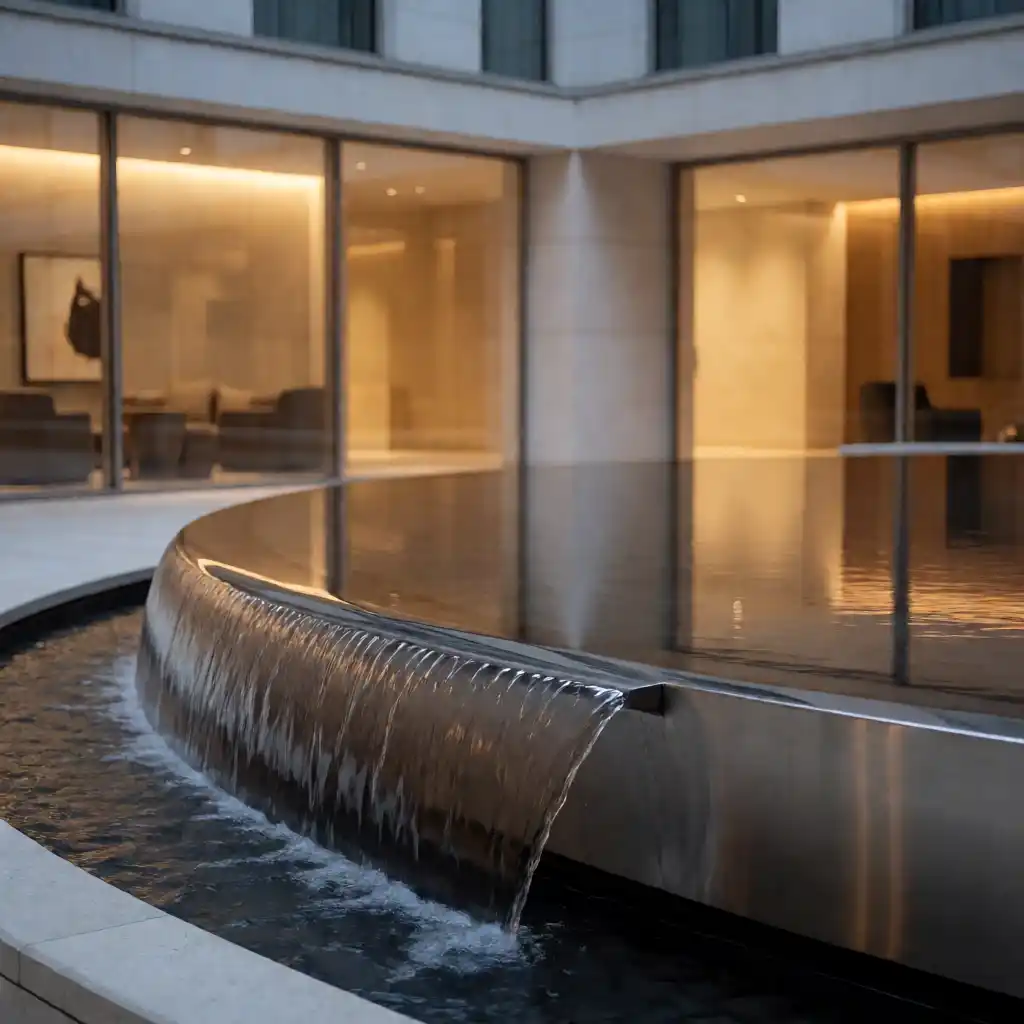
Above all, the rim joint must be sealed and welded, not gasketed. Water under pressure always finds a gasket that was adequate on the drawing. A fully welded, passivated rim seam costs a little more in fabrication and removes the most common leak path in the whole assembly — which matters far more than adding another half-millimetre of steel thickness.
Wind spray and the surrounding surfaces
Wind is the variable that turns a two-millimetre overflow into a two-metre spray zone. The physics is simple: the falling sheet has almost no mass, so a crosswind of 5 m/s carries droplets well beyond the basin, and a 10 m/s gust can strip the sheet entirely off the rim on the windward side.
Every water feature specification should carry a wind spray radius — the horizontal distance from the rim that will be wetted at the site’s design wind speed. It is a real number, measured or modelled, and it should appear in the drawings so the landscape architect can plan around it.
Practical answers, in order of preference:
- Reduce flow on the windward side, or zone the rim so the exposed lip runs at lower volume while the sheltered lip carries the full sheet.
- Baffle or screen the exposed side with a glass, steel or planting screen at least the height of the fall.
- Drip trays beneath the likely wet zone, with drainage, for paving and stone.
- Sacrificial barriers — gravel margins, tolerant planting or replaceable stone — where hard finishes or plantings will otherwise stain with mineral deposits.
A courtyard that is sheltered on three sides behaves completely differently from a rooftop or an exposed plaza. The hotel courtyard water feature sits in a semi-enclosed space where spray is measured in centimetres, while the same rim on a rooftop would need screening and reduced flow.
Freeze protection for a stainless steel water feature
In cold climates, freeze damage destroys more water features than corrosion ever will. Water expands by about nine per cent when it turns to ice, and that expansion will split a pump body, crack a welded lining and shear pipework long before the steel shows any sign of rust. Freezing is a structural event, not a cosmetic one.
Protection is chosen by climate, and there are three levels:
- Low-flow recirculation — keeping the pump running through cold nights so moving water does not freeze. Adequate for occasional light frosts.
- Heated pump chambers or trace heating — insulated housings with thermostatically controlled heating cable on exposed pipework, for sites that drop below freezing intermittently.
- Full drain-down systems — sloped pipework, low-point drains and isolation valves so the entire system can be emptied and left dry for the season.
Be honest about the design temperature. A site that regularly sits below −5 °C needs a drain-down design, not a heated one. Heating an outdoor basin through a continental winter burns more energy than the feature is worth, and one power failure at the wrong moment undoes the whole strategy. Water held in constant contact with steel also raises the stakes on alloy choice: standing water in a recirculating system justifies marine-grade 316 rather than 304 stainless, especially where chlorides or coastal air are present.
A water feature engineering checklist
Use this table during design review. Every row is a decision that costs a fraction of its eventual repair if it is made before the concrete is poured.
| System | Specification | Failure mode | Cost to fix later |
|---|---|---|---|
| Pump station | Flow and head calculated together; pump curve delivers duty flow at 80% of max head; sump sized for full basin volume plus surge | Weak film, dry patches on the rim, pump cavitation and impeller wear | High — new pump, possible pipe resizing, drain and refill |
| Filtration | Full turnover every 1–2 hours; cartridge or pressure filter sized to feature volume; surface skimmer; UV or dosing where sunlit | Algae within 2–4 weeks, cloudy water, stained rim and paving | Medium — retrofit filtration and extra sump space |
| Overflow edge | Drip edge plus return channel at 1:100 fall, jigged straight, fully welded and passivated rim joint | Leaks at the rim seam, water clinging to fascia, bowing under load | Very high — cutting and re-welding an installed rim |
| Wind protection | Wind spray radius stated in the drawings; windward flow reduction or baffle; drip trays with drainage | Water loss, saturated paving, mineral staining, unhappy neighbours | Medium — retrofitted screens and drainage are visible after the fact |
| Freeze protection | Climate-appropriate strategy: low-flow recirculation, trace heating, or full drain-down with low-point drains | Split pump bodies, cracked lining, sheared pipework in the first hard winter | Very high — structural repairs to the steel itself |
| Access for maintenance | Removable grille over the sump, isolating valves, filter reachable without draining the feature, pump liftable by two people | Every routine task becomes a major intervention; filters get skipped | High — re-cutting the surround or installing an access hatch |
Maintenance that keeps it running
Water features fail slowly before they fail loudly. A circulation loop that is cleaned on a schedule runs for years without drama; the same loop left alone becomes a green basin, then a seized pump, then a permanently stained rim.
- Weekly, in season: clean the filter basket and skimmer, check the water level, and look at the sheet over the rim for dry patches or fingering.
- Monthly: backwash the pressure filter or replace the cartridge element, and check the dosing or UV system.
- Seasonally: inspect the pump for noise, vibration and flow loss; check all valves and isolation points; re-check the water chemistry balance.
- Annually: realign the lip and the return channel, clear any mineral scale from the rim edge, and verify the spray pattern is still even across the full width.
- Once a year, at the end of the season: drain the system down, inspect the internal surface of the stainless lining for pitting or staining, and confirm the low-point drains are clear before refilling.
The surface side of the same routine — cleaning, polishing and protecting the visible steel — is covered in our outdoor stainless steel sculpture maintenance guide. Together, the hydraulic checks and the surface care are what keep a water feature looking and behaving like new.
Have a project in mind?
Water feature engineering is where the quote is made or lost. The pan and the rim are visible; the pump station, filtration loop, overflow channel and freeze strategy are what determine the real cost and the real lifespan of the piece. That is why we price from the hydraulic design rather than the drawing alone — the same silhouette can differ substantially once flow, head and climate are resolved. Our stainless steel sculpture cost guide explains how those variables move a budget. If you have a site, a basin size and a rough idea of the effect you want, send them across and we will come back with a hydraulic design, a bill of materials and an indicative budget band. Request a quote for your stainless steel water feature and we will take it from there.
More from the Workshop



Have a Project in Mind?
Send your brief and get a free, honest quote within 24 hours — no obligation.
Request a Quote