
Stainless Steel Wall Art, Reliefs and Water Walls: A Design and Engineering Guide
September 23, 2026
Wall-mounted sculpture is usually specified late, after the cladding, the lighting and the concrete are fixed. That order is backwards, and it is the most common reason a stainless steel wall art commission ends up compromised: a relief that cannot be moved, a panel that ripples under grazing light, or a water wall with nowhere to hide its sump.
This guide covers the three objects that get called wall art — the wall-mounted relief, the free-standing panel and the true water wall — and the engineering that decides whether each still looks right after five years.
Three objects that get called wall art
The first decision is structural, not aesthetic: the three constructions carry different loads, waterproofing obligations and maintenance profiles.
A wall-mounted relief is a sculptural layer applied to an existing wall. It carries no water and no self-supporting load, so its structure is mostly a question of how it hangs. Depth runs from about 60 mm for a shallow folded composition to 400 mm or more for a modelled figure group, which makes it the most forgiving of the three on cost and the most dependent on the wall behind it.
A free-standing wall panel is a self-supporting plate, usually 1.5 to 6 m high, on its own base or tied back to a frame. Wind governs: a 3 m by 4 m panel in an open plaza can attract several tonnes of horizontal force at design wind speed, and that force has to reach a foundation.
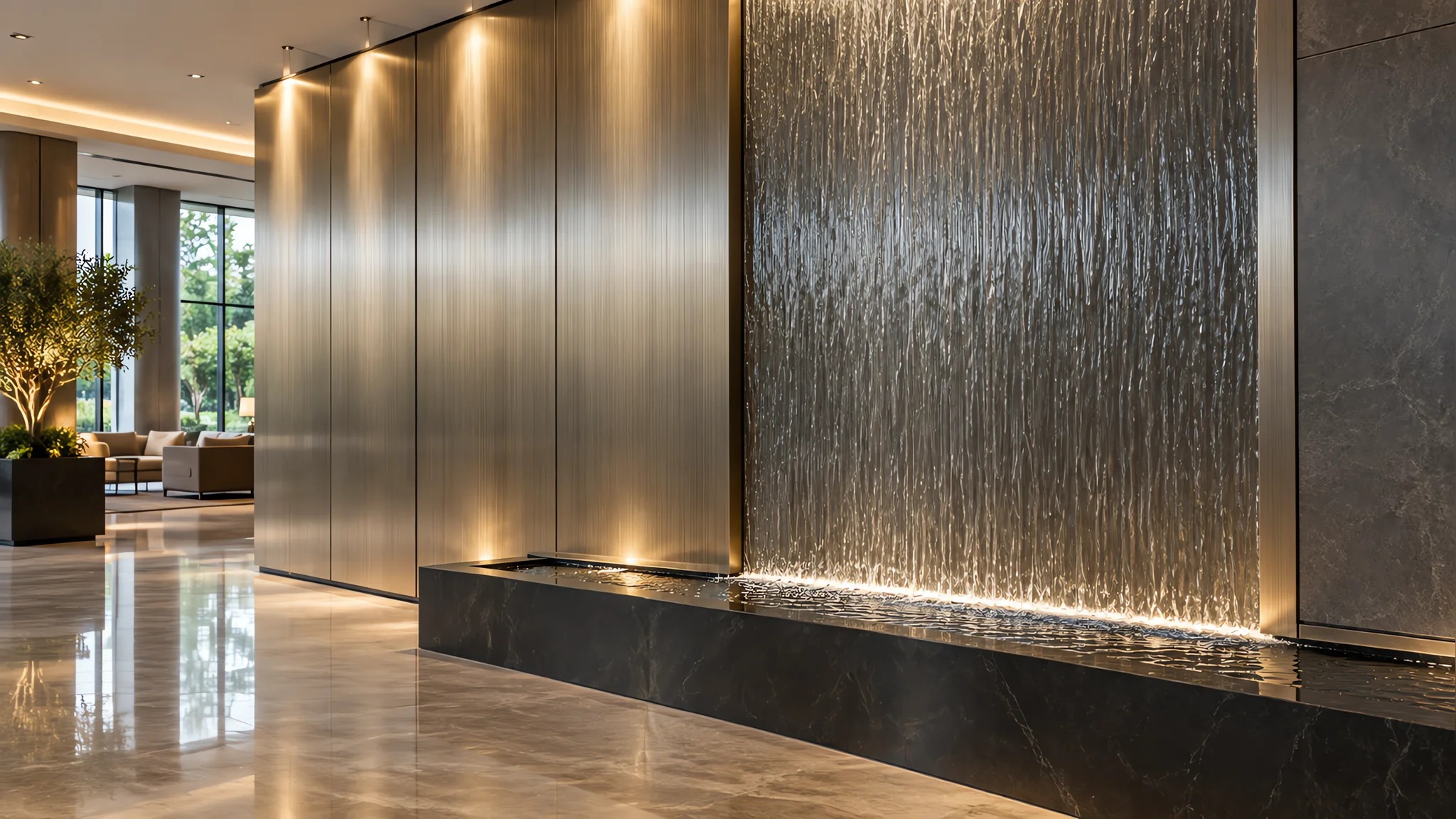
A true water wall is a hydraulic machine with a sculptural face. Water is pumped to a head tank at the top, released over a lip as a continuous sheet, and collected in a catch basin before returning to the pump. It needs power, water, drainage, filtration and a maintenance route — an order of magnitude harder than a static panel of the same size.
The wall behind the piece: substrate and structure
A relief can be fixed to concrete, masonry, a steel frame or composite cladding, but each accepts a different fixing and tolerates a different amount of movement. Concrete and masonry take mechanical anchors well and move very little. A steel frame moves with temperature and needs slotted, not rigid, connections. Composite cladding is usually not designed for point loads at all, so a secondary rail system must go behind it.
Two details decide how the piece reads. The standoff — the gap between the back of the relief and the wall face — should be 40 to 80 mm, which lets the piece cast its own shadow line and hides the waviness of an older wall. The gap must also drain and ventilate: sealed top and bottom, moisture trapped behind the steel has nowhere to go, and a coastal or humid site will show staining within a season. The wall is part of the composition: a mirror-polished piece against dark masonry reads as a floating object, while the same piece against a bright, flat wall loses its edge.
Panel fabrication: flatness, seams and grain
Flatness separates a professional stainless steel wall panel sculpture from a merely competent one. Large thin plates oil-can: they deflect between welds and read as shallow dents under directional light. The fix is fabrication-led — a stiffening return or hidden rib frame on the back, plate thickness of 2 mm or more for large faces, and a controlled welding sequence to limit distortion.
Seam placement should be drawn, not discovered. A seam running through a modelled face reads as a hard line in raking light, so seams belong along a fold, behind a return, or at a deliberate horizontal. Edge returns of 20 to 40 mm fold the edge out of sight and stiffen the panel at the same time.
Grain direction is the detail most often missed. Brushed and hairline finishes are directional; if two adjacent panels are brushed in opposite directions, the joint becomes a visible change of tone that no polishing will remove. Every panel in one composition must be brushed the same way, and that direction recorded on the shop drawing.
Mounting systems and movement
Four systems cover most wall work. Cleats hook into matching wall brackets and allow the piece to be lifted off for maintenance. Z-clips are a shallow variant for lighter reliefs. Concealed rails let a long composition slide into position and be adjusted laterally before locking, which is the practical answer for multi-panel facades.
Whatever the system, stainless steel moves. An exterior panel 6 m long sees roughly 4.8 mm of expansion across a 40 °C swing, so every fixing must allow for it or the panel will bow or crack its welds. The standard answer is a fixed point at the centre with slotted holes at the ends. Wind is the other load, and the wind loading calculations for large stainless sculptures apply directly to tall free-standing panels.
A water wall is a hydraulic system
Everything above applies to a water wall, and then the hydraulics begin.
Head tank, weir box and the sheet
Water must arrive at the top evenly. A head tank or weir box holds a shallow reservoir behind the lip so the level is constant across the full width; without it the sheet arrives thick at one end and thins to a dribble at the other. The lip is levelled to within a millimetre over its length, because a 2 mm bow over 4 m shows as a dry patch.
Catch basin, return and flow rate
Below the wall, a catch basin collects the sheet and returns it to the pump. A clean, unbroken film needs roughly 40 to 60 litres per minute for every metre of lip width, so a 4 m wall demands 160 to 240 L/min at the actual working head, not at zero head. Friction in the pipework, valves and filter typically adds 1.5 to 3 m of head, so a pump chosen on volume alone arrives underperforming.
Drip lip, splash and treatment
Under the lip, a drip edge breaks the water cleanly so it does not cling to the fascia. Around the basin, a splash zone must be declared — a falling film of almost no mass is easily carried sideways by a 5 m/s crosswind — and the surrounding paving planned around it. Untreated recirculating water grows visible algae in two to four weeks, so a filter plus UV or dosing is part of the specification. The full engineering, including pump sizing worked examples and freeze strategy, is in our guide to stainless steel water feature engineering.
Interior and exterior water walls are different projects
An indoor water wall is an acoustic and humidity problem. Evaporation from a large sheet raises relative humidity in a lobby, and that moisture must be removed by ventilation or it condenses on cold glazing. Moving water is also loud: a 3 m sheet at 200 L/min produces continuous noise that is pleasant in a spa and unacceptable beside a reception desk. An indoor wall needs a sealed basin, a ventilation allowance and usually a sound-isolated pump enclosure.
An outdoor wall is a weather and freeze problem. Drainage must handle rain as well as overflow, and any climate that drops below freezing needs a climate-appropriate strategy: low-flow recirculation for light frosts, trace heating for intermittent freezes, or a full drain-down design with low-point drains for sites regularly below −5 °C. Constant water contact also justifies a higher alloy, as set out in our comparison of 316 versus 304 stainless for outdoor sculpture.
Finishes on a vertical plane
A finish behaves differently on a wall than on a sphere. A mirror polish reflects whatever faces it — a plaza, a car park, a service door — and that reflection becomes part of the artwork whether intended or not. Brushed and hairline finishes scatter light, hold their tone under changing conditions and hide fingerprints and light rain marks far better. The trade-offs are compared in our guide to stainless steel sculpture finishes.
Light the wall before you fabricate it
Lighting should be decided before fabrication, because the light determines what the metal must do. Grazing light, thrown almost parallel to the surface, reveals every fold, ripple and weld — the harshest test of flatness and the most dramatic treatment for a relief. Wall-wash light, aimed at the wall from a distance, flattens the piece and suits a free-standing panel seen from across a space. Fitting positions, distance and beam angle all change the fabrication tolerance — decide the lighting after the steel is welded and you accept whatever the metal already does.
Scale and proportion
- Lobby wall. Roughly 40 to 60 per cent of the wall width, within the field of view from the main approach, base at or slightly below eye level. A relief depth of 100 to 250 mm reads well at the 2 to 6 m viewing distance typical of a lobby.
- Hotel facade. Read from 20 m or more, so it must carry at a distance: larger scale, fewer elements, stronger contrast. A composition of 4 to 12 m across, with a generous standoff so the shadow line survives daylight.
- Exterior plaza screen. Read from both sides and in silhouette, so negative space matters as much as the metal. Panels 3 to 6 m high, spaced to allow walking through, with the structure designed from the site’s design wind speed.
What drives the cost
Cost follows the engineering, not the silhouette. Alloy, plate thickness, finish grade, panel count and seam complexity set the fabrication cost; foundations, fixings and access set installation; and the hydraulics — pump, filtration, basin, drainage and controls — set the cost of a water wall.
| Factor | Wall-mounted relief | Free-standing panel | True water wall |
|---|---|---|---|
| Primary structural demand | Fixing and wall capacity | Wind load and foundation | Wind load, water weight and basin |
| Waterproofing scope | None | None | Full — basin, lip, returns, penetrations |
| Services required | Lighting only | Lighting, possibly power | Power, water supply, drain, controls |
| Fabrication risk | Low — flatness and finish | Medium — flatness, structure, transport | High — hydraulics plus everything above |
| Typical delivery time | 6 to 10 weeks | 10 to 16 weeks | 14 to 24 weeks |
| Maintenance profile | Occasional cleaning | Cleaning and fixing checks | Weekly to monthly water care |
| Cost drivers | Area, finish, alloy | Area, finish, base and erection | Hydraulics, filtration, waterproofing |
The published stainless steel sculpture cost guide breaks these drivers into indicative bands. A water wall and a static panel of the same size can differ in cost by a factor of two or more, and almost all of that difference sits below the water line.
Have a project in mind?
Wall work is decided in the details: the standoff, the seam layout, the grain direction, the pump curve, and who takes responsibility for the wall behind the piece. Send us the wall dimensions, the substrate, the viewing distance and the effect you are after, and we will come back with a fabrication approach, a mounting scheme and an indicative budget band. Request a quote for your stainless steel wall art or water wall, or browse our wall art projects and water feature work to see how the two are built in practice.
More from the Workshop

Have a Project in Mind?
Send your brief and get a free, honest quote within 24 hours — no obligation.
Request a Quote