
Stainless Steel Sculpture Finishes Explained: Mirror, Brushed, Hairline & Bead-Blasted
September 18, 2026
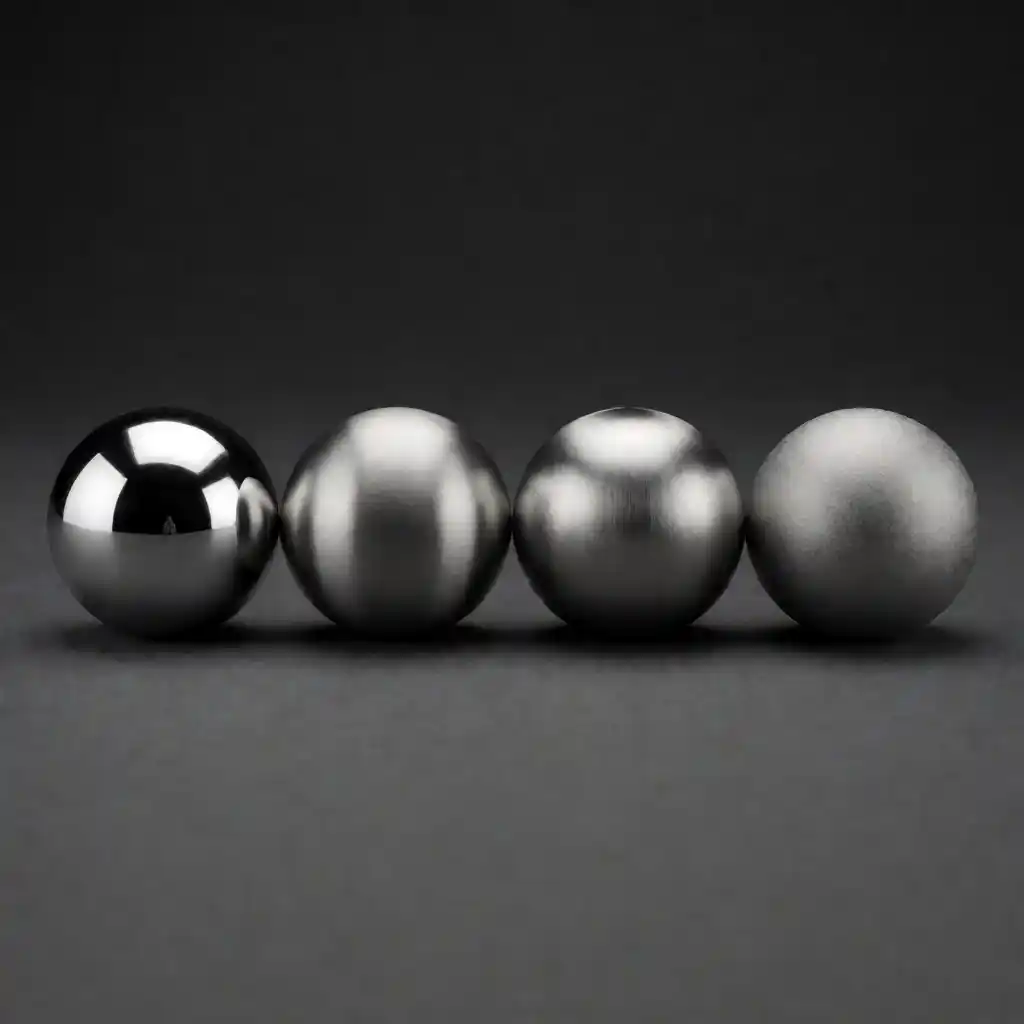
On a polished form, the stainless steel sculpture finish is the sculpture. Fabrication gives the piece its shape; the surface is what a visitor actually sees, photographs and remembers. It is the last thing applied and the first thing that can go wrong — a scratch, a weld ghost, a fingerprint trail or a patch of water spotting will undo months of shaping in a single season. This guide covers the four finishes we produce most often: mirror-polished, satin brushed, hairline and bead-blasted.
Why the finish is the most expensive part of the sculpture
Clients are often surprised that the metal is not the expensive part. Stainless plate is a commodity; the hours that turn it into a flawless reflective skin are not. On a mirror commission, finishing routinely accounts for 30–50% of shop time and, on complex double-curvature work, more than half.
A mirror surface cannot be sprayed, dipped or bought. It is built in stages, by hand, and each stage must erase the marks of the one before it:
- Weld dressing. Every seam is ground flush, then re-ground finer, because a mirror never lies about a weld — a 0.2 mm ridge becomes a distortion that travels across the panel.
- Progressive abrasion. The surface is worked through a grit sequence, typically 80 up to 800–1500, each pass removing the scratches of the previous one.
- Layout and inspection. Polishing happens under controlled raking light, section by section, with panels tilted so the operator sees what a passer-by sees at grazing angle.
- Buffing and passivation. Cutting compound, a fine rouge stage, then cleaning and acid passivation to restore the chromium-oxide layer that polishing disturbed.
Finish is therefore not only aesthetic but a durability decision. The more reflective a surface, the more it shows: water spotting, fingerprints, micro-scratching and the chloride pitting that eventually breaks the passive layer. A matte surface often outlasts a mirror on a hostile site, not because the steel differs but because it has less to lose. See how that lands in the quotation in our breakdown of what drives stainless steel sculpture cost.
Mirror-polished
Mirror polishing takes the surface to a near-optical finish, typically 8K or No. 8 on the mill scale, where a reflection is essentially undistorted. It is the finish most people picture when they hear “stainless steel sculpture,” and the one that most reliably turns a piece into a landmark.
What a mirror finish looks like
The metal stops reading as metal and starts reading as a curved mirror. It takes its colour from its environment: grey sky becomes soft silver, sunset becomes bronze, planting becomes green-gold. Edges appear to dissolve, and a sphere genuinely reads as a sphere because you can see the world wrapping around it.
What mirror polishing costs
Against a bead-blasted baseline, expect a mirror finish to add roughly 2–4× to finishing cost on the same geometry — and the multiplier climbs with surface area, on curved panels, and wherever a weld falls across a visible face.
What a mirror finish is vulnerable to
- Water spotting. Rain or irrigation left to dry leaves mineral rings that etch in; in hard-water regions this happens within weeks outdoors.
- Fingerprints. Skin oils bloom into dull patches, fastest at the height people touch.
- Scratches. Any contact leaves a bright line that cannot be spot-repaired; a mirror panel usually has to be re-polished as a whole field.
- Chloride pitting. Coastal air or chlorinated water attacks the passive layer at the polish’s fine grain boundaries, producing pinhead pits that bloom outward.
Where a mirror finish earns its place
Mirror is right in dark or enclosed interiors, where a reflective skin doubles the light; for landmarks meant to be photographed; and for water features where the reflection of the piece and of the water reinforce each other. Our mirror ball garden installation is the third case — the ball’s whole visual argument depends on the polish.
Satin / brushed
Satin, or brushed, is the mid-range compromise and the finish we specify most often for architectural work. The surface carries a fine directional grain, produced by running an abrasive belt in one consistent direction, that softens reflections without killing them. There is still sheen and still a sense of metal, but the piece no longer behaves like a mirror.
The advantage is forgiveness. Scratches that would be obvious damage on mirror disappear into the grain, water spots dry to far less visible residue, and fingerprints read as nothing. Cost sits meaningfully below mirror and above bead-blasted: a moderate premium rather than a multiple.
Grain direction is where satin finishes are won or lost, and it matters most on curves:
- Consistent direction. Usually vertical on wall panels, so light raking down the face reads evenly, and horizontal on handrails and trims.
- Curves change the reading. On a compound-curved form a single grain direction appears to rotate as the surface turns away. Good satin work either follows the form’s principal curvature or is finished so uniformly that no banding shows.
- Weld zones. Joins must be re-grained locally to match their surroundings; grain running against its neighbours is the most common satin defect, and it shows only after installation, at grazing angle.
- Repairability. Satin is genuinely field-repairable — a damaged area can be re-grained on site to blend in, which is effectively impossible with mirror.
For lobby entrances, interior feature walls and sheltered architectural pieces, satin gives the best ratio of impact to long-term effort.
Hairline
Hairline is a finer linear finish than satin: a very light, continuous grain with low surface roughness, historically specified as No. 4 and now more often described by the abrasive grit used. It reads as a soft directional glow — clearly not mirror, but far closer to reflective than brushed work.
The boundary between hairline and brushed is not technical. Both are directional abrasion finishes; grit, pressure and passes decide which you get, and the same steel can be taken to either. What separates them in practice is commercial: the term the specifier writes down, the sample they approve, and the surface the shop is willing to defend under that name. Two suppliers can deliver “brushed” stainless that differ visibly — one a coarse grey scuff, the other a feather-fine sheen.
Hairline suits work where a satin grain looks too coarse but mirror is too demanding: reception counters, elevator interiors, signage bands, and the secondary faces of large sculptures where a mirror front would otherwise force you to polish the back.
Because the grain is fine, hairline sits closer to mirror in care requirements than brushed does. Always ask for a physical sample: in this finish the name alone carries very little information.
Bead-blasted
Bead-blasting bombards the surface with fine glass or ceramic beads under pressure, peening it into a uniform matte texture. Light arriving at the surface scatters instead of reflecting coherently, so the result is a soft matte grey that reads as a solid colour. On the mill scale this family sits at the matte end, roughly No. 6 or a specified surface-roughness (Ra) reading.
For outdoor sculpture, bead-blasting is often simply the right answer, and the reason is maintenance rather than aesthetics:
- It hides what mirror punishes. Water spotting, dust films, bird lime and light handling marks blend into the texture instead of standing out against it.
- It survives public contact. On an exposed plaza, a high-gloss surface will not stay glossy — and a mirror that has lost its perfection looks worse than a matte that never claimed any.
- It holds sealant. The micro-texture gives protective treatments something to key into, which extended-life sealing systems need.
- It is uniform across a large form. Slight reflection variation between panels — the thing that ruins large brushed or mirrored assemblies — is far less noticeable on matte.
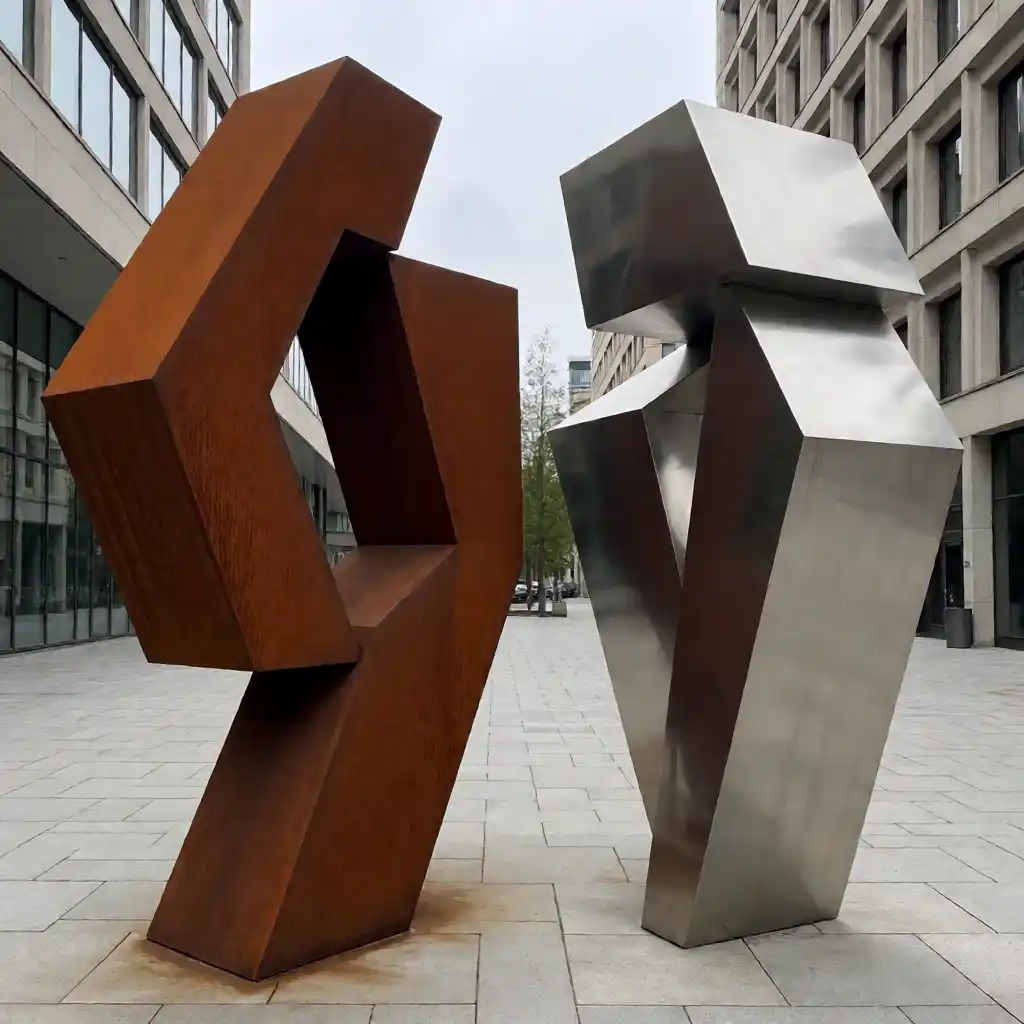
The trade-off is that a matte finish cannot afterwards be made to look like a mirror, and it mutes crisp edges and fine detail. If the design’s whole point is a perfect reflection, bead-blasting is wrong; if the piece must live outdoors, in public, in weather, it is usually right. Our geometric park sculpture uses a matte outdoor treatment for that reason: the forms carry the piece, and the surface still looks intended in year ten rather than year one.
A stainless steel sculpture finish comparison table
The table summarises the four finishes across the dimensions that matter in a real specification. Cost premiums are quoted against bead-blasted as the baseline.
| Finish | Reflectivity | Cost premium vs bead-blasted | Maintenance effort | Best sites | Worst sites |
|---|---|---|---|---|---|
| Mirror-polished | Near-optical; undistorted reflection | 2–4×, highest on large curved welded faces | High — routine cleaning; re-polish by field | Dark interiors, reflective landmarks, water features, photographed focal points | Coastal air, chlorinated pools, public plazas within reach |
| Satin brushed | Directional sheen; soft reflection, no image | About 1.3–1.8× | Moderate — field-repairable; scratches blend into grain | Interior feature walls, lobby entrances, architectural screens | Salt-spray coastal exposure; areas scuffed hard |
| Hairline | Fine directional glow, nearer reflective than brushed | About 1.5–2.2× | Moderate to high — grain shows prints more than brushed | Reception counters, elevator interiors, signage bands | Public touch zones, coastal sites, high-traffic outdoor floors |
| Bead-blasted | Matte — diffuse, low reflectance | Baseline (1×) | Low — marks blend in; no polishing required | Exposed outdoor sculpture, public plazas, parks, coastal sites | Dark interiors where reflection is the intent; work needing sharp-edge crispness |
Two things follow. Maintenance effort is a decision made at specification time, not a cost discovered later — a finish that is cheaper to buy is often more expensive to own. And surface condition is only half the durability story: a bead-blasted skin will not save a piece whose welds or brackets are under-designed, which is why finish sits alongside structural condition in our guidance on wind loading on large stainless steel sculptures and in our outdoor stainless steel sculpture maintenance guide.
Finish and site: matching a stainless steel sculpture finish to the site
Finishes are chosen in a studio but judged on site. The table pairs the installation contexts we see most with the finish that performs best in each.
| Site type | Recommended finish | Why | Maintenance expectation |
|---|---|---|---|
| Indoor dark gallery | Mirror-polished | Reflective skin multiplies available light; the controlled environment removes water and chloride risk | Dust and print clean-down a few times a year; occasional re-polish on touch zones |
| Indoor bright lobby | Satin brushed, hairline on feature faces | Daylight or downlighting on mirror produces glare and hotspot banding; a directional grain softens the same light | Wipe-down as normal housekeeping; local re-graining of scuffs on site |
| Coastal outdoor | Bead-blasted, in 316-grade steel | Chlorides attack polished grain boundaries first; matte surface plus molybdenum-bearing alloy resist salt | Fresh-water rinse on a set cycle, periodic sealant renewal, no polishing |
| Public plaza | Bead-blasted, satin only above reach height | Contact, abrasion and graffiti risk exceed what a fine sheen is worth; matte absorbs everyday wear | Wash-downs, plus occasional re-blasting of low panels |
| Pool or constant-water feature | Satin or bead-blasted; mirror only above the splash line, in 316 or better | Constant water contact carries chlorides and minerals to every surface; spots etch mirror within weeks | Highest of all — scheduled seal inspection, splash-zone cleaning, periodic refinishing |
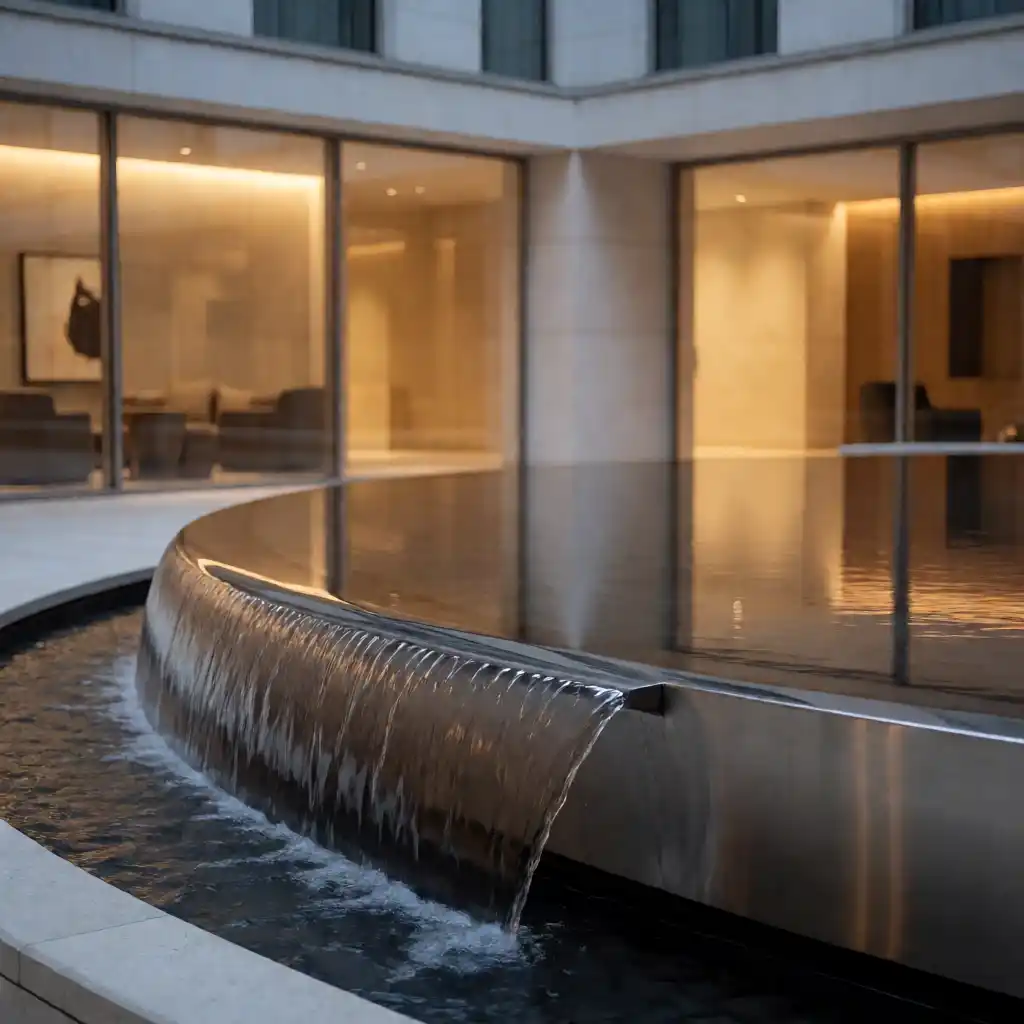
Where a site involves constant water contact, the finish question is inseparable from the alloy question. Our hotel water wall is a case in point: the specification that survives a wet environment combines a water-tolerant finish with a molybdenum-bearing grade, explained in our comparison of 316 versus 304 stainless for sculpture.
How to specify a finish so you get what you paid for
Most finish disputes are not caused by a shop doing bad work, but by a specification that named a finish without defining it, so two parties left with different pictures of the same word. Put the following in writing before fabrication starts:
- Name the finish and code it. Write a plain-English description and a recognised classification — for example mirror, 8K / No. 8 equivalent, satin brushed, grain vertical, or bead-blasted, matte, target Ra 1.2 µm. On the older industry scale this may appear as 2D, 4D or 8B, but never let the code stand alone.
- Agree a target gloss reading or a physical sample. Insist on a signed-off metal coupon of the same alloy and thickness, and record the gloss reading at the agreed angle. A sample converts “brushed” from an opinion into a reference object.
- State how welds and seams are hidden. Say which joints must be fully blended, how blending is done in each finish, and which faces are class-A visible surfaces.
- Specify the protective sealant. Name the product, or at least the class — an inert nano-coating for the splash zone, or a wax system for a sheltered satin piece — and say whether it is applied at the factory, on site, or both.
- Attach a maintenance plan. Include cleaning frequency, approved agents (never chlorinated or abrasive cleaners, never steel wool), the re-sealing interval and who carries it out.
- Write the remedy if the delivered surface does not match. Include an acceptance step comparing delivered panels against the approved sample under raking light, and a written remedy — re-finishing or replacement of the affected panel at the supplier’s cost — if it fails.
The finish is agreed at the same sign-off gate as geometry, alloy and anchor design, which is how our own sculpture making process sequences it: sample approval first, production second. A supplier’s willingness to put a finish in writing also says a lot about how they work — see the checklist in our guide to choosing a stainless steel sculpture manufacturer.
Have a project in mind?
Mirror, satin, hairline and bead-blasted are four answers to one question, and the right one depends on where the piece will stand, how it will be lit and how much care it will realistically receive. Send us the location, the approximate scale and the look you are after, and we will come back with a recommended finish, the alloy that supports it and an honest view of the maintenance it implies. Request a quotation for your stainless steel sculpture and we will specify the surface as carefully as the form.
More from the Workshop

Have a Project in Mind?
Send your brief and get a free, honest quote within 24 hours — no obligation.
Request a Quote