
How to Choose a Stainless Steel Sculpture Manufacturer: A Vetting Guide
September 18, 2026
Commissioning a large stainless steel piece is not a purchase — it is a project you hand to someone else and wait for. You approve a render, pay a deposit, and then the object exists in a workshop you will probably never visit, made by people you will probably never meet. That gap is where almost every disappointing sculpture comes from. When a project goes wrong, the honest post-mortem rarely blames the welder: it blames the choice of a stainless steel sculpture manufacturer who could not engineer the piece, could not hold the finish, or could not put the promises in writing. This guide is the due diligence that has to happen before the first deposit, not after the crate is opened.
Why vendor selection is the real risk
On a commission, the buyer is absent during fabrication. You cannot stand over the jig, check the wall thickness of the tube being welded, or look at the polish under raking light at the moment it matters. Everything you will ever know about the piece is what you negotiated in advance and what arrives in the container. That makes the selection decision — not the drawing, not the price — the single highest-leverage choice in the project.
The risk is also misdiagnosed. Buyers worry that the sculpture will look bad in the rendering, but renderings are cheap and easy to iterate. The failures that actually hurt are administrative and structural:
- Delivered wrong. The grade is not what you specified, the wall thickness is lighter, the polished face has weld bloom or orange-peel distortion, or the mounting plate does not match the foundation drawing.
- Delivered late. A missed installation window means a crane booked for nothing, a plaza opening without its centrepiece, or a hotel that has to explain an empty plinth to guests.
- Cannot be installed. The piece arrives without lifting points, without an engineered base detail, or split into sections no truck or crane on site can handle.
None of those are fabrication accidents. They are selection failures — and they are decided long before steel is cut. The rest of this guide is a method for closing the information gap while you still have leverage.
The six criteria that actually matter in a stainless steel sculpture manufacturer
A shortlist built on price alone will fail. These are the six things worth scoring, in the order they tend to cause trouble. Use them as a scorecard before you ask for money to change hands.
| Criterion | What good looks like | What it protects you from |
|---|---|---|
| Engineering capability | Wind load, structural and foundation drawings issued as documents | A beautiful object that cannot legally or physically be installed |
| Finish quality | Consistent grain, no weld bloom, mirror or satin held across sections | A piece that looks patched in daylight |
| Grade discipline | 316 actually shipped when 316 is specified, with mill certificates | Premature corrosion in coastal or poolside settings |
| Communication cadence | Scheduled progress updates with photographs at fixed milestones | Discovering a problem at delivery |
| Delivery & installation record | Referenceable installed work, lifting plan, site team | A crate on the pavement and no plan |
| Warranty | Written coverage of finish and structure, with a remedy process | Paying twice for the same defect |
a. Engineering capability
The first question is whether the shop can produce engineering drawings at all — wind load calculations, internal structural framing, connection details, and a foundation or anchorage design that a local engineer of record can review. A shop that only draws the silhouette is a fabricator, not a sculpture manufacturer, and the difference shows up at permit stage. For a worked example of what this looks like on a large piece, see the wind loading calculations behind a large stainless sculpture, and the airport landmark project where the base detail was engineered alongside the artwork.
b. Finish quality and how they hold a polished surface
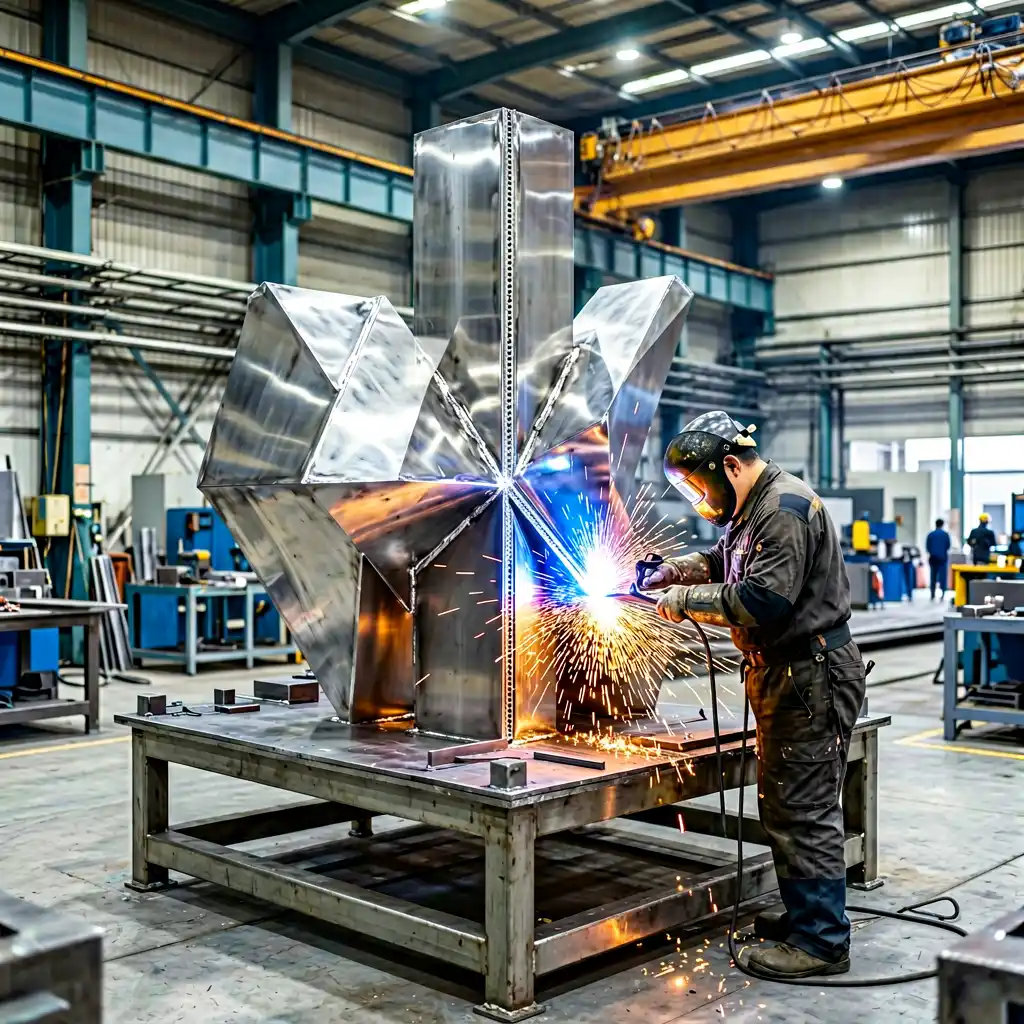
Finish is where small shops most often overpromise. Ask how the surface is prepared before polishing, how weld seams are dressed so they do not telegraph through the finish, and whether the polishing sequence is done after all fabrication — not before the last bracket is welded on. A mirror finish is a maintenance commitment as much as a manufacturing one; a satin or brushed finish hides far more site damage. Judge the shop on photographs of finished work in daylight, not in a spotlight.
c. Grade discipline
“Stainless” is not a specification. Grade 304 and grade 316 behave very differently outdoors, and the one that is right for a rooftop is not always right for a seafront. A serious shop will name the grade, name the wall thickness, and supply mill certificates. Our guide to 316 versus 304 stainless steel for outdoor sculpture explains where the line falls, and the coastal sculpture project shows a 316 marine-grade build in practice.
d. Communication cadence
Ask what you will receive and when: progress photographs at defined milestones, notice before a change, and a named person who owns the account. A shop that goes quiet between deposit and shipping is not a shop that will surprise you pleasantly. Cadence is the cheapest early-warning system you have.
e. Delivery and installation record
Delivery is part of the product. Ask for the lifting plan, the section weights, and the largest single piece that must move through the site. Then ask for a referenceable installation, and actually look at it. A shop with installed work you can visit has already solved the problems you are about to discover.
f. What the warranty covers
Read the warranty as a scope document. Does it cover finish defects, weld failure, and structural integrity? For how long, from what date, and what is the process when a claim is valid — repair, replacement, or credit? A one-line warranty is a marketing sentence, not a commitment.
Red flags to walk away from
Most bad outcomes were visible in the first two conversations. These are the signals that should stop a commission before the deposit, even when the price is attractive.
- No engineering drawings at all. If structural and foundation details are “not needed” or “handled on site”, the piece is being designed by the installer.
- A price that is 40% below the market. Steel is a commodity; nobody sells it below cost. A large gap is being recovered somewhere — thinner wall, cheaper grade, skipped finishing, or a base that you will pay to fix later.
- “We use stainless” with no grade or wall thickness specified. The absence of a number is the specification.
- No referenceable installed work. Photographs of workshop pieces are not installations. Ask for a site, a client, and a date — and expect all three.
- Resistance to a written spec. A shop that pushes back on a written specification sheet is telling you which parts of it they do not want to be held to.
- Deposit demands with no milestones. If payment is front-loaded without delivery or installation milestones, you are financing the project and carrying the risk.
Questions to ask a stainless steel sculpture manufacturer before you sign
Ten questions, each with the answer you should be listening for. If you cannot get the “want” answer in writing, that is data.
- “What grade and wall thickness will you use, and where will it be written?” Want: in the specification sheet, not only in an email thread.
- “Who signs off the engineering?” Want: a named engineer, a registration or stamp, and drawings you can forward to your local engineer of record.
- “Can you supply mill certificates for the steel?” Want: yes, with the delivery paperwork — traceability is standard practice for a serious shop.
- “How will weld seams be treated before finishing?” Want: a described dressing and polishing sequence, done after all fabrication is complete.
- “What finish will you sample, and can I approve it?” Want: a physical sample or a raking-light photograph approved before the final polish.
- “What happens if the finish is wrong on arrival?” Want: a remedy clause — repair, refinish, or replacement, with the shop carrying the cost and the logistics.
- “What is the largest section, and what lifting points will it have?” Want: numbers, plus a lifting and rigging plan for your site.
- “Which installations can I visit or call?” Want: two or three referenceable sites with contact names, not a photo gallery.
- “How and when will you update me during fabrication?” Want: a fixed cadence with progress photographs at named milestones.
- “What exactly does the warranty cover, for how long?” Want: structure and finish named explicitly, with a stated claim process.
A manufacturer comparison table
Not every project needs the same kind of shop. This is an honest map of the trade — not a ranking of any named company — so you can match the vendor type to the risk your project carries.
| Vendor type | Typical project size | Engineering drawings | Grade & wall-thickness spec | Finish hold | Warranty | Best fit |
|---|---|---|---|---|---|---|
| Small workshop | Under ~1.5 m, indoor or sheltered | Rarely issued; sometimes a sketch | Often stated verbally, rarely certified | Localised; difficult to hold across sections | Short or informal | Small decorative pieces, prototypes, tight budgets on low-risk sites |
| Mid-size fabricator | ~1.5–4 m, commercial interiors and plazas | Basic structural and base drawings | Grade and thickness written on the quote | Good on flat and simple forms | 1–2 years, defects-based | Hotel, retail and commercial pieces with moderate wind and access needs |
| Specialist architectural shop | Over ~4 m and/or exposed, coastal or public art | Full wind load, structural and foundation packages | Certified grade and wall thickness, with traceability | Controlled across complex double-curvature forms | Multi-year, structure and finish named | Landmarks, seafront and rooftop sites, permit-stage public projects |
Read the table as a risk ladder. The further up you go in scale and exposure, the more of the engineering, specification and warranty column you should refuse to do without — and the more you should expect the price to reflect it.
How to read a quote like a specifier
A good quote is a breakdown; a vague one is a single line. The difference is not administrative — it determines who owns the risk when something is missing. A well-itemised quote from a stainless steel sculpture manufacturer will separate:
- Design. Concept development and 3D modelling, including revisions.
- Engineering. Wind load, structural and foundation drawings, and any stamping or review.
- Fabrication. Steel grade, wall thickness, framing, welding and shop hours.
- Finish. Preparation, polishing or brushing, and any protective coating.
- Freight. Packaging, crating, sea or road freight, and insurance.
- Installation. Site team, rigging, lifting equipment and cranage.
- Contingency. A defined allowance for site conditions, or an explicit exclusion.
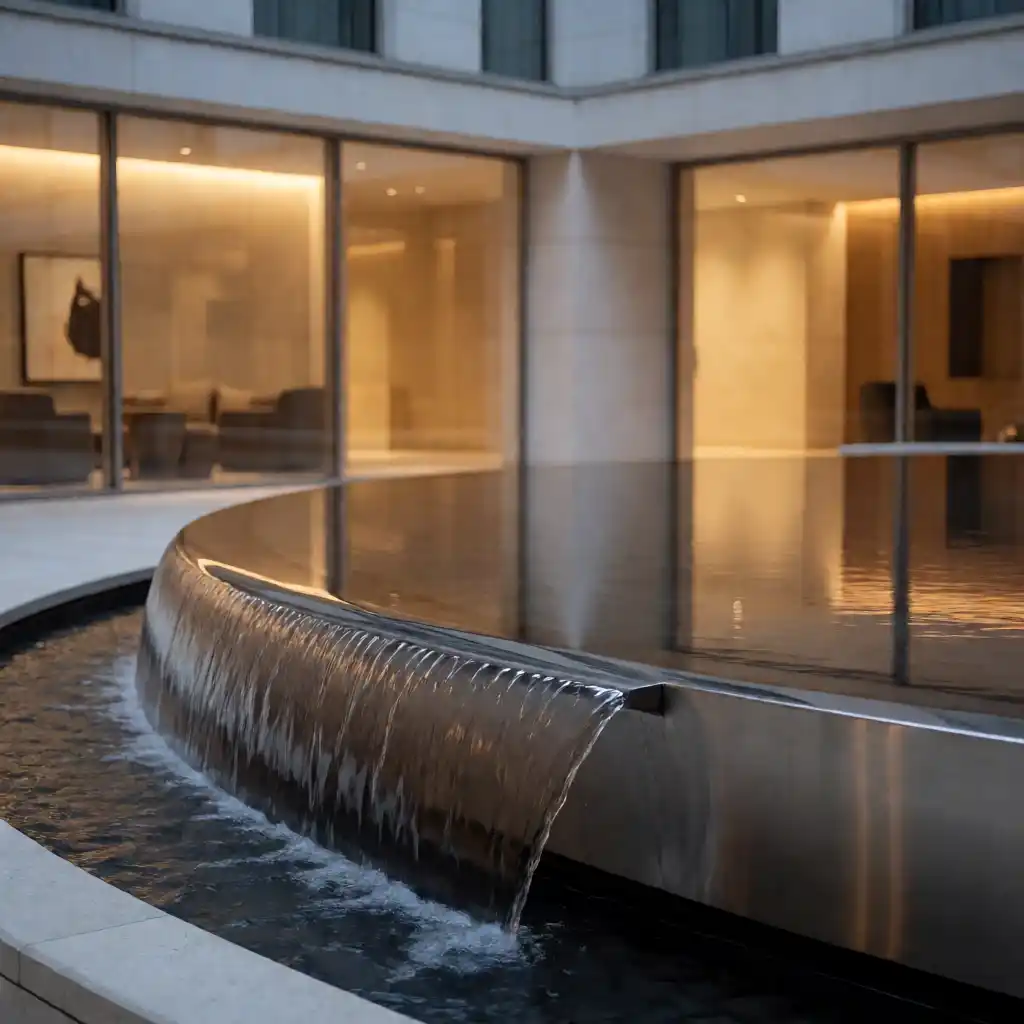
When a quote collapses all of that into “fabrication”, every item that is not mentioned becomes your problem. That is what a lump-sum quote actually is: a risk transfer into the buyer, priced below the real scope and settled later, on site, under time pressure. For a sense of how design, engineering, fabrication and finishing each move the number — and how a fully-itemised package comes together on a built project — see the plaza fountain project in our works archive.
The contract checklist
Whatever the quote looks like, these eight items should appear in the agreement before a deposit moves. If a shop resists any of them, that is your answer about fit. Our own commissioning process is built around this same sequence.
- Fixed dimensions and tolerances. Overall size, plus an acceptable deviation — a sculpture is a fabricated object, not a machined part.
- Grade and wall thickness. Named in the contract, with mill certificates on delivery.
- Finish specification. Mirror, satin or brushed, with the approved sample attached as an annex.
- Milestone payments. Tied to delivery and installation events, not to calendar dates alone.
- Engineering sign-off. Drawings issued for review, with a named engineer and stated standards.
- Remedy clause for finish defects. Defined process, cost bearer, and timeline for repair or replacement.
- IP and ownership of the 3D model. Who owns the design files, and whether the manufacturer can reuse or resell the form.
- Timeline with liquidated consequences. Dates for fabrication, shipping and installation, and what happens if they slip.
Have a project in mind?
Selection is the part of a sculpture commission you can still control completely. Get the grade, the engineering, the finish and the milestones in writing, and the fabrication takes care of itself. If you are planning a stainless steel piece and want the engineering, finish and delivery questions answered up front, send us your project brief and request a quote — you will get a specification-led response, not a lump sum.
More from the Workshop

Have a Project in Mind?
Send your brief and get a free, honest quote within 24 hours — no obligation.
Request a Quote