
Custom Stainless Steel Animal Sculpture Guide
September 23, 2026
Animals are the most requested figurative commission in landscape work: a stag on a roundabout, cranes at a hotel’s water’s edge, something children recognise from fifty metres. The brief is nearly always the same — make it look like the real thing, make it last outdoors, make it safe.
Stainless steel can do all three, but only if the animal is treated as an anatomy problem before a metal problem. This guide covers how a custom stainless steel animal sculpture is designed, fabricated and sited, assuming a grasp of how stainless steel sculptures are made from plate to installation.
Why animals are harder than they look
A viewer who has never studied anatomy still carries enormous subconscious data about animals. They cannot tell you the cannon bone should be roughly a quarter of the leg length, or that eye-to-muzzle distance on a horse is close to skull depth — but they feel it instantly when it is wrong.
In practice, a 5% proportion error is enough to make an animal read as “wrong”, even to someone who cannot say why. A 4 m horse with a head 5% too large looks like a toy; a stag with a neck 5% too short looks domesticated. Abstract work tolerates a 20% deviation; an animal does not. This is why cheap animal sculpture is obvious: the fabricator copied a photograph outline instead of reconstructing the skeleton beneath it.
Posture compounds the problem. A standing quadruped carries most weight on two diagonal legs, the other two acting as props. A neutral pose is simple to build but looks stiff; a rearing or mid-stride pose reads beautifully and becomes genuinely difficult to engineer.
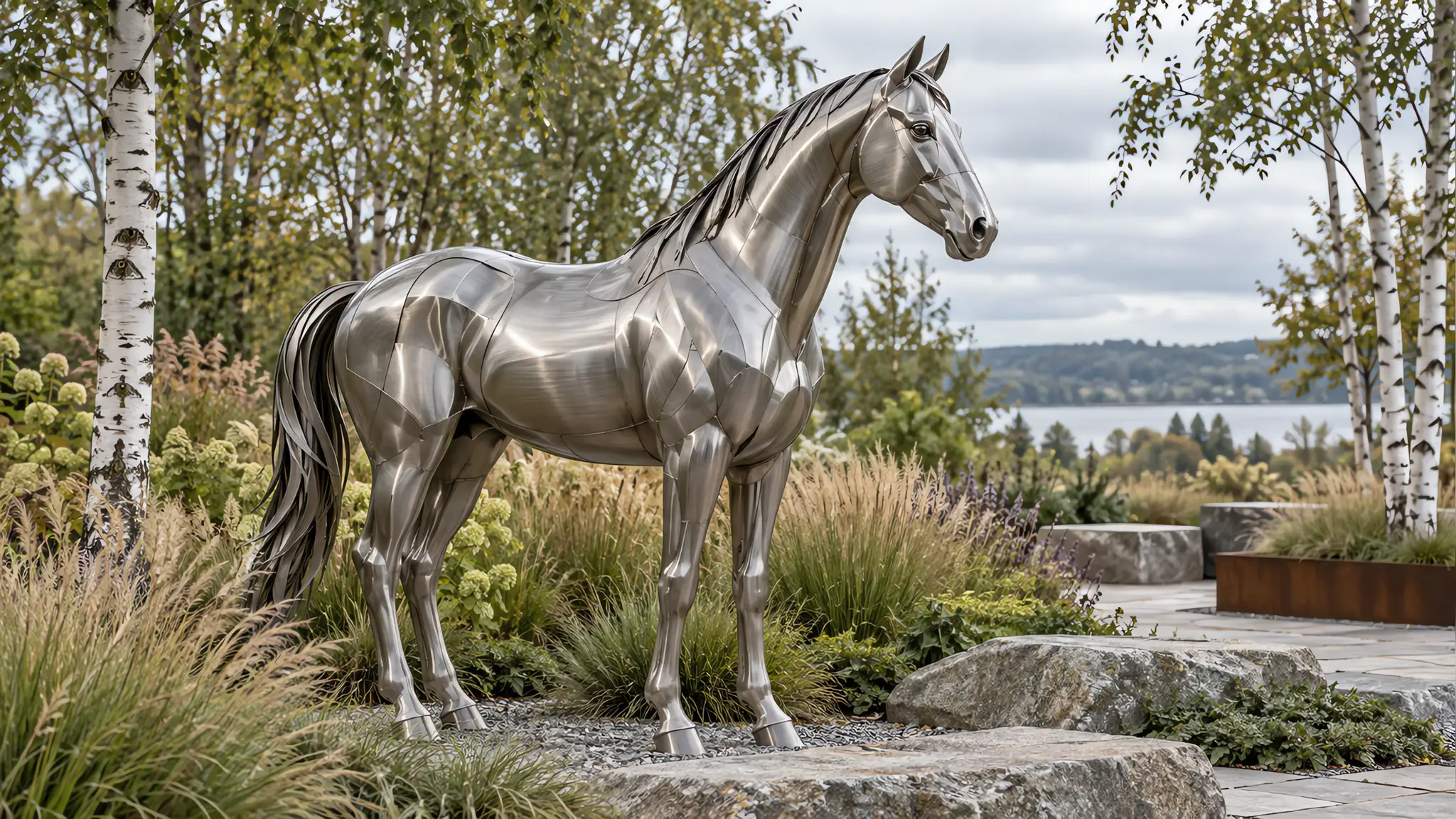
Anatomy first: the design process
Every serious project starts with references: photographs from at least four angles, skeletal diagrams, and for a portrait animal a measurement sheet for the species and breed. Photographs must include a scale reference in frame, because a photo without scale cannot fix proportion. From these we build a measured proportion table — total height, body length, shoulder height, head length, leg segments, neck angle — the contract every later stage is checked against. It is the cheapest quality-control tool in the process.
The first physical output is a maquette at 1:8 or 1:10 scale, where proportion is judged in three dimensions and the client signs off the pose. Changes at maquette stage cost hours; changes after plate cutting cost weeks. From an approved maquette there are two routes: a 3D scan followed by digital surface development, which gives clean section curves and predictable panel layout, or hand enlargement over an armature, which gives a more organic surface. For complex poses we do both — scan for structure, refine by hand.
How a hollow plate animal is built
A large animal is not cast and not solid. It is a hollow shell fabricated from stainless plate, typically 2–4 mm thick depending on span and load. The sequence runs:
- Internal armature — a steel skeleton on a levelled base plate, carrying the load and defining the centreline.
- Sectioning — the model is sliced into stations 150–250 mm apart on a 4 m animal, each becoming a plate template.
- Forming — panels cut by laser or plasma, then rolled or hand-formed to the station curve.
- Tack and check — panels verified against the proportion table before full welding.
- Full weld and dress — TIG welded and refined until panel edges disappear.
Seam placement separates good work from average work, and no amount of grinding hides a badly placed seam. Good practice runs seams along natural body lines: spine, shoulder crease, flank, jaw line, underside of the tail. A seam across the cheek or down a thigh always reads as a scar, because the eye expects continuous form. On furry animals we also break up large flat panels deliberately — a smooth 3 m flank in mirror looks like a vehicle panel, while shallow overlapping plates read as muscle and coat.
Surface and texture: fur, feather and hide
Sheet stainless cannot reproduce fine texture; it reproduces form and suggestion:
- Smooth hide (horse, bull, deer, big cats) — excellent. The body reads as a continuous brushed or polished surface.
- Shaggy coat (sheep, yak, bear) — workable using overlapping plate clumps and directional grinding; reads as coat at 5 m, as abstracted mass at 1 m.
- Fine feather detail (cranes, herons, eagles) — only suggested. Lifted feather edges are possible, but a fully feathered bird in sheet steel looks like scales.
- Scales and skin pattern (fish, reptiles) — best achieved with bead-blasted zones or applied plate, not literal modelling.
Finish matters as much as form. A mirror finish amplifies every surface error — reflections turn a 2 mm panel wave into visible distortion — so it suits simple, strong forms. A brushed or bead-blasted finish forgives small waves and reads as natural coat, which is why most realistic animals are finished brushed or bead-blasted. The trade-offs are set out in our guide to stainless steel sculpture finishes.
Scale options and how the engineering changes
The same animal at a different scale is a different engineering problem.
| Scale | Typical size | Wall thickness | Base / anchoring | Structural concern |
|---|---|---|---|---|
| Tabletop | 0.3–0.8 m | 1.5–2 mm | None; felt or stone pad | Handling only |
| Garden | 1–2 m | 2 mm | Small plate or ground spike | Stability in wind; theft |
| Park / plaza | 2–4 m | 3 mm | Concrete plinth, chemical anchors | Wind load, leg section, weld fatigue |
| Monumental | 4–8 m+ | 3–5 mm | Engineered foundation, cast-in anchors | Full structural calculation, lifting, transport |
The jump from garden to monumental is not cosmetic. A 4 m rearing horse is a structural problem, not a sculptural one. The pose puts all mass above one pair of hind legs, which act as a cantilever: the leg section must be sized for bending, the base plate must transfer a large overturning moment into the foundation, and the anchors must resist uplift on the windward side. Wind usually governs — a 4 m animal on an exposed site can see design pressures above 1 kPa, and load scales with the square of wind speed.
Choosing the material: 304, 316, corten and bronze
Stainless is not one material; grade choice follows atmosphere and water contact.
- 304 stainless — the default for inland, sheltered sites. Excellent in rural and most urban atmospheres, lower cost than 316, unsuitable where chlorides are present.
- 316 stainless — contains molybdenum, which resists chloride pitting. This is the correct grade for coastal sites, poolside and spa areas, and any piece splashed with pool water. Beside a water feature, 316 is the specification, not an upgrade.
- Corten steel — forms a stable rust patina and suits rural settings at lower cost, but the patina runs and stains adjacent paving, and it performs poorly near salt or in consistently wet coastal air. It cannot be polished.
- Bronze — traditional for fine figurative work. It holds detail better than sheet steel and ages with a warm patina, but is far heavier and typically two to three times the cost of an equivalent stainless piece, with longer lead times.
Where a client wants bronze’s warmth on a steel budget, a hand-applied bronze patina over stainless is a genuine option. The full comparison is in stainless steel versus bronze for sculpture, and the corrosion case for coastal work in 316 stainless steel as a sculpture material.
Siting and landscape integration
A plinth raises the piece, protects the base from soil moisture and gives it a formal presence; direct-ground siting reads more natural for grazing animals, but needs a hidden foundation and careful drainage so soil contact does not become a corrosion site — manageable on 316, risky on 304 in a wet climate.
Realistic animals reward close approach, while abstract animals often read better from a distance, where the silhouette carries; decide which experience you want before choosing the finish. Uplighting from the base flatters almost any animal and should be designed in, with conduit cast into the foundation rather than added later. Check sightlines from both the main approach and any elevated vantage point. Our park and landscape sculpture applications show how these patterns are applied.
Maintenance
Outdoors, stainless steel animal sculpture needs little — but not nothing. Wash with fresh water and a soft cloth every three to six months to remove airborne salts and organic film; coastal and poolside pieces benefit from a rinse every four to eight weeks. Avoid abrasive pads on brushed finishes and chlorine-based cleaners on any grade. If a clear coat is used, plan re-application every three to five years, and inspect welds and anchors annually on monumental pieces.
Lead time and cost drivers
Two same-sized animals can differ in price threefold, and rarely because of the metal. The drivers, in order of impact, are pose complexity (standing vs rearing vs mid-leap), surface detail (smooth hide vs shaggy coat vs feather groups), finish (brushed vs mirror, since mirror needs far more dressing labour), grade (304 vs 316) and installation scope (freestanding delivery vs foundation and commissioning). Cost is driven by labour hours far more than material weight.
| Size | Typical lead time | Indicative cost range |
|---|---|---|
| Tabletop, 0.3–0.8 m | 3–5 weeks | Low four figures |
| Garden, 1–2 m | 6–10 weeks | Mid four to low five figures |
| Park / plaza, 2–4 m | 10–16 weeks | Low to mid five figures |
| Monumental, 4 m+ | 16–26 weeks | Mid five figures and up |
Our stainless steel sculpture cost guide breaks these drivers down further, including how to structure a budget for a competitive tender.
Decision table: four common approaches
| Approach | Best for | Form fidelity | Maintenance | Relative cost | Watch out for |
|---|---|---|---|---|---|
| Mirror-finish abstract animal | Plazas, hotel entrances, strong silhouettes | Low — form and gesture only | Low, but shows fingerprints and water spots | Medium | Mirror amplifies panel waves; needs excellent forming |
| Brushed realistic animal | Parks, gardens, estates, wildlife trails | High — proportion-critical | Low | Medium to high | Proportion errors are unforgiving; finish must suit species |
| Corten animal | Rural landscapes, nature reserves, trails | Medium | Very low, but stains surroundings | Low to medium | Run-off staining; unsuitable near salt or permanently wet sites |
| Bronze animal | Heritage, memorial, prestige figurative work | Highest — finest detail | Low; patina evolves | High | Weight, cost, longer lead time, theft risk on smaller pieces |
Most large public projects land on brushed or bead-blasted stainless in grade 316 for anything within reach of water, and 304 for dry inland sites. Mirror is a deliberate aesthetic choice, not a default.
Have a project in mind?
The earlier the fabrication team is involved, the more of the cost you control. Send us your species, pose intent, approximate size, site location and exposure, and we will come back with a proportion proposal, a recommended grade and finish, and an indicative programme. Start with a quote request for your custom animal sculpture, or browse the animal sculpture gallery to see how other briefs have been resolved.
More from the Workshop
Have a Project in Mind?
Send your brief and get a free, honest quote within 24 hours — no obligation.
Request a Quote