
Roundabout and Landmark Sculpture: A Guide to Design, Engineering and Approvals
September 23, 2026
A roundabout sculpture is not art that happens to sit on a traffic island. For a public art roundabout scheme, it is infrastructure doing three jobs at once: marking a place, guiding people through it, and surviving everything a roadside throws at it — and for councils, transport authorities, developers and their consultants, whether it still works in thirty years is decided long before the first fabrication drawing.
What a roundabout sculpture is actually for
A wayfinding marker
A marker tells a driver they have arrived and that the next turn matters. It works by being repeatable: the same silhouette on every approach, read in a fraction of a second. Priority is a strong closed outline, high contrast and enough height to clear island planting; detail is wasted.
A place-making gesture
A place-making piece speaks to residents as much as passing traffic, so it can carry a story. If the brief is about identity rather than traffic, the piece probably belongs on a nearby square — a commercial plaza or forecourt offers more room and far fewer approvals.
A gateway to a district
A gateway sculpture announces a boundary: a city centre edge, a business park, a waterfront. These are the largest pieces, often paired with signage and lighting, and the form must read as a threshold from both directions — usually near-symmetry and a base that does not look like an afterthought. If the purpose needs the word “and” to describe it, one purpose will lose.
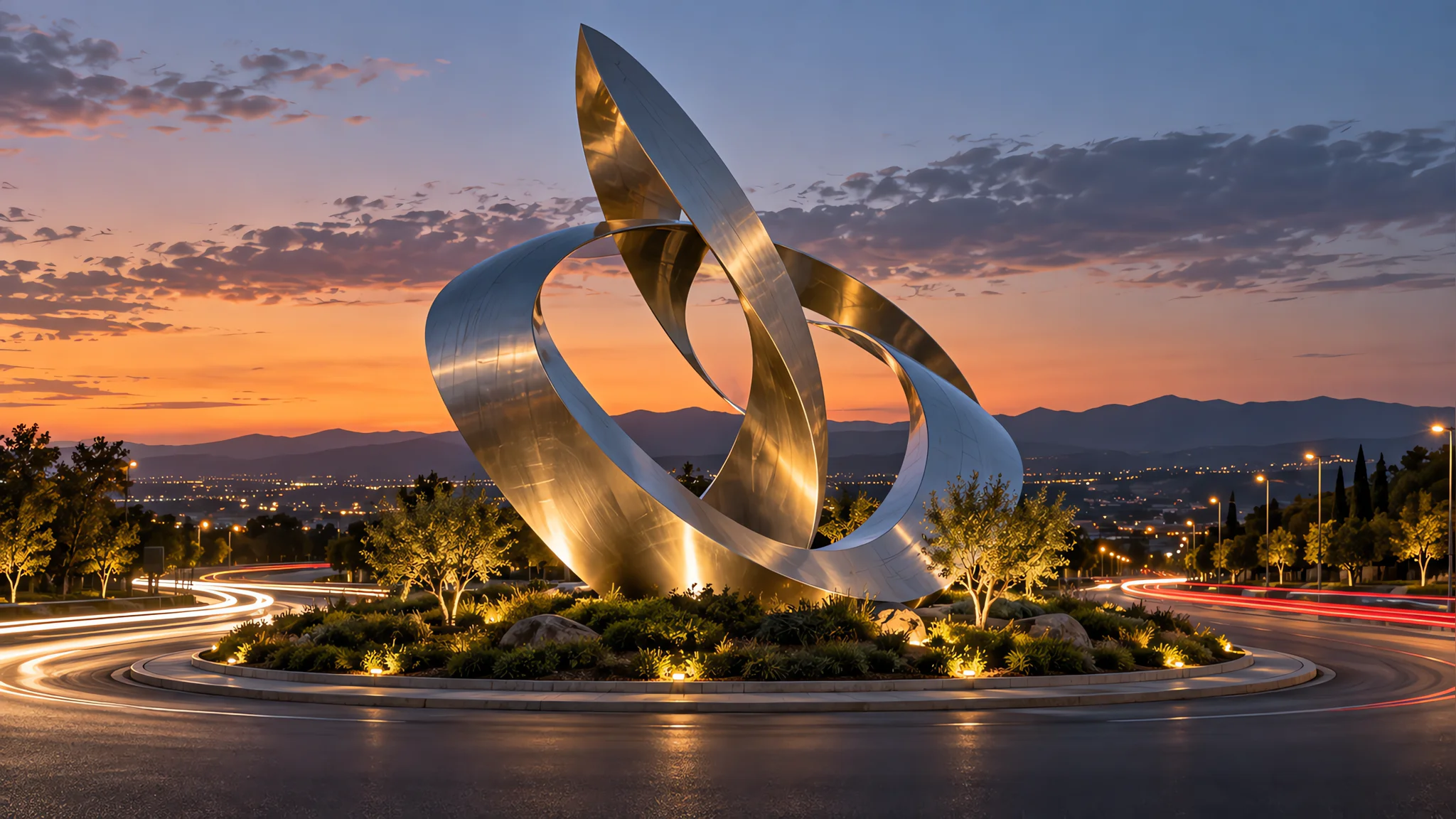
The 30–60 km/h problem: silhouettes, not detail
The audience is a driver approaching at 30–60 km/h who has the piece in view for three to six seconds, in which the eye registers outline, mass and contrast — not surface or texture.
The classic failure is a beautiful maquette: a 300 mm model on a desk invites detail, and the client approves the detail, but on site the piece is 6 m tall and 40 m away and the detail vanishes into a grey silhouette against a grey sky. Test the form filled solid black at 10 % of its size. Where detail is genuinely needed, put it low and keep the upper mass simple — the approach used for abstract sculpture.
Visibility, sightlines and road safety
Visibility cuts both ways: the piece must be seen, and must not stop anything else being seen. Roundabout design relies on clear sight triangles between the give-way line and the circulating carriageway, and a landmark inside one will be moved or removed. It must not mask approaching or circulating vehicles from any approach, and must not compete with directional and warning signs, which take priority.
Manage distraction deliberately — some is the point, but avoid high-frequency movement, flashing and glints at the driver’s eye line. A mirror surface facing an approach can also throw low sun into a windscreen. Get a road safety audit opinion before the design is fixed; changing a silhouette is far cheaper than changing a foundation.
The approvals gauntlet — and how to sequence it
A roundabout landmark needs four separate consents, and they are not sequential. Treating them as a queue loses a year.
- Highways or transport authority — owns the island and carriageway; tests sightlines, distraction, sign clutter and maintenance access.
- Planning authority — advertised signage, tall structures, conservation areas and illumination; listed settings add a heritage consultee.
- Structural certification — independent check of structure, base and fixings against wind and dynamic loading.
- Public consultation — often required where public money is spent; it covers concept and story, not engineering.
Sequence it so the design is not locked before approval: site constraints, two or three concept silhouettes tested against the motion and sky views, pre-application advice, a road safety audit opinion on the shortlisted form, and outline structural feasibility. Only then freeze the design, submit planning and produce certified structural drawings; a concept taken straight to a full fabrication package turns any objection into an expensive redesign.
Engineering reality on a traffic island
Wind load. An island offers no shelter and nothing to break the flow. Design pressures are calculated on the full height and projected area with a gust factor: a 6 m form with a 3 m² projected area can carry several kilonewtons of wind load, arriving as a bending moment at the base rather than a simple push. This governs any large stainless sculpture in an exposed location, and a tall, thin silhouette can be impossible on a small island.
Dynamic loading. Passing lorries and buses produce a moving pressure pulse and a wake — for a tall, flat form close to the carriageway a repeated load affecting base fixings and weld fatigue.
Base in a constrained footprint. A 4–6 m island leaves 2–3 m of usable width once the apron, planting and services are excluded, and that footprint must resist the overturning moment with an adequate factor of safety. The options are a ballasted spread base, a piled solution or a mass concrete pad; choosing between them needs ground information.
Foundation work under traffic management. Everything below the island surface happens under traffic management: lane closures or temporary signals, and reinstatement to the authority’s specification. Ground investigation alone may need a night possession, so this is a real cost and programme constraint.
Material selection for a roadside environment
A roundabout is hostile to a finished surface: road salt, de-icing spray, exhaust fallout, brake dust and, in some locations, deliberate damage or vehicle impact. Chlorides attack lower grades of stainless, so grade 316, with its molybdenum content, resists pitting far better than 304, and brushed, bead-blasted or patinated finishes hide deposits that a mirror surface would advertise. Graffiti is best resisted by a satin or textured finish.
Mirror polish is the default on renders and almost never right on an island: it demands the most maintenance, shows every smudge, throws sun glints at drivers and is hardest to touch up. Grade 316 in a satin or bead-blasted finish weathers to a stable, even appearance that reads clean from 40 m, and the fabrication route — forming, welding, dressing and passivating — matters as much as the grade; see how stainless steel sculptures are actually made.
Maintenance access without closing the roundabout
Plan cleaning, inspection and repair access before installation, because the access method shapes the design; a landmark that needs a lane closure to change a lamp will be neglected. Keep fixings, lamp housings and accessible joints within reach of a van-mounted platform working from the apron, and provide a maintenance pull-off where the authority allows.
Lighting: the landmark has to work at night
A roundabout is seen in the dark for much of the year and in flat, low light for much of the day, so a scheme that only works in summer sunshine is unfinished. Uplighting or grazing emphasises mass and silhouette, while flooding the whole island only creates glare; fittings should be aimed away from approach sightlines with shielded optics, because glare to a driver is a safety objection. The island may also have no supply at all, in which case a new connection is often a ducted route under the carriageway from the nearest cabinet. Solar and battery suits low-draw accent lighting but needs a secure enclosure and a realistic duty cycle; it is worth deciding whether the piece reads acceptably unlit.
Scale: island diameter, approach speed and viewing distance
Scale for a landmark sculpture follows from the island and the approach speed; the table is a starting point for feasibility, not a substitute for a site-specific sightline check.
| Island diameter | Approach speed | Indicative height | Notes |
|---|---|---|---|
| Under 3 m | Any | 1.5–2.5 m | Low mass only. |
| 3–5 m | 30–40 km/h | 2.5–4 m | Wayfinding markers, gateway signage. |
| 5–8 m | 40–50 km/h | 4–6 m | Typical district gateway landmark. |
| Over 8 m | 50–60 km/h | 6–9 m | Large landmark; piled base normally required. |
Raise the height if surrounding planting is tall or the backdrop is busy, and reduce it if the island sits on a tight circulating path; height should be set by the sightline envelope first and the aesthetic second.
Timeline from concept to switch-on
A realistic programme for a mid-sized landmark:
- Concept and site analysis — 4 to 8 weeks.
- Pre-application advice and road safety audit — 4 to 8 weeks, in parallel.
- Public consultation — 4 to 6 weeks where required.
- Planning submission to determination — 8 to 16 weeks.
- Structural design and certification — 4 to 8 weeks, overlapping planning.
- Procurement and fabrication — 10 to 20 weeks.
- Ground investigation and base construction — 2 to 6 weeks, under traffic management.
- Installation, connection and commissioning — 1 to 3 weeks, under possession.
Twelve to eighteen months is a fair expectation for a public scheme with consultation and planning.
Budget bands and the hidden costs
Fabrication cost is the smallest part of the whole-life figure. Indicative shares for a supplied and installed 4–6 m landmark:
| Element | Share | Driven by |
|---|---|---|
| Sculpture fabrication and finish | 35–50 % | Size, complexity, grade, finish |
| Structural base and fixings | 10–20 % | Ground, overturning moment |
| Traffic management and possessions | 10–20 % | Number of night possessions |
| Ground investigation | 2–5 % | Boreholes, services surveys |
| Certification and design fees | 5–10 % | Independent check |
| Electrical supply and lighting | 5–15 % | Distance to supply, luminaires |
| Landscaping and reinstatement | 3–8 % | Authority specification |
Traffic management, ground investigation, certification and the electrical connection are the costs most often left out of a first estimate; together they can add 25–40 % to a fabrication-only figure. Briefing a manufacturer early — asking the questions set out in how to choose a stainless steel sculpture manufacturer — surfaces them before the budget is committed.
Decision table: four ways to treat a roundabout
Most schemes resolve into one of four approaches. The comparison sets out where each earns its place.
| Option | Best suited to | Approvals burden | Maintenance | Cost |
|---|---|---|---|---|
| Stainless steel landmark | Gateway or district marker, 4–9 m, with power supply | Highest — safety audit, planning, certification | Moderate — annual washdown; grade 316 stays stable | High |
| Corten steel landmark | Landscape or park approaches, industrial settings | Similar to stainless; certification required | Low on finish, higher on staining | Medium–high |
| Stone plinth with a metal piece | Smaller islands, conservation areas | Moderate — masonry and heritage consultees | Low — stone robust | Medium |
| Lighting-only treatment | Islands with no room for a structure | Lowest — glare still needs a safety review | Ongoing — lamps fail | Low |
Stainless and corten are the two options that create a genuine landmark, and the choice is usually about context rather than cost: corten suits informal, landscape-led settings, while stainless suits urban and gateway locations wanting a clean, controlled appearance — see the comparison of stainless steel versus corten for public art. A stone plinth is often the pragmatic answer on a small island, and a lighting-only treatment can legitimately hold a site until funding is secured; schemes with room for planting are covered under park and landscape installations.
Have a project in mind?
If you are scoping a roundabout or gateway landmark and want to test the form against wind load, sightlines and a realistic base footprint before the design is committed, send us the island dimensions, the approach speeds and the intended purpose. We can advise on grade, finish, structural feasibility and programme.
Start with a request for a quote, or review our completed sculpture projects.
More from the Workshop
Have a Project in Mind?
Send your brief and get a free, honest quote within 24 hours — no obligation.
Request a Quote