
Stainless Steel vs Corten for Outdoor Public Art: Which to Specify?
September 18, 2026
Ask most fabricators whether to use corten or stainless and you will get the cheaper answer first, because corten genuinely is cheaper. Corten is the more dramatic-looking option too: within two years it turns the deep rust-orange that clients photograph and architects keep specifying. What the buyer is usually not told is what corten costs later — the staining, the cleaning, the surfaces around it that were never budgeted for a rust halo. This guide walks through the stainless steel vs corten decision the way we actually make it with clients: material science first, then honest cost, then the weathering and runoff behaviour that decides most projects in the end. Corten is the right answer more often than stainless-only fabricators admit. It is also the wrong answer in a handful of situations where nobody warns the client until the plaza is already stained.
Stainless steel vs corten: what each material actually is
Corten is a family of low-alloy weathering steels — the name is a Cor-Ten trademark, and the relevant grades are SA 524 in the US and 409-type weathering steel in the EU. The alloy is deliberately designed to corrode, but only to a point. As the surface oxidises, the outer layer forms dense iron oxides that slow further corrosion; the result is a stable, rust-coloured patina that protects the steel underneath. The critical detail that decides site planning: that layer is not instant and it is not passive. It needs repeated wet-and-dry cycles to build and stabilise, which is why corten behaves very differently in a rainy coastal city than under a dry awning.
Stainless steel works on the opposite principle. Grades 304 and 316 resist corrosion because of chromium in the alloy — at least 10.5% — which forms an invisible passive oxide film over the surface. If the film is scratched it re-forms immediately in the presence of oxygen. 316 adds molybdenum, which is what makes it hold up in chlorides: salt spray, swimming pools, de-icing salt. In normal service, neither grade rusts. You can browse the full range of finishes and grades we work in on our materials and finishes page.
- Corten (SA 524 / 409): corrodes on purpose, forms a stable patina, needs water and time to develop, and sheds iron oxide as runoff.
- Stainless 304: passive chromium layer, no rust in normal outdoor service, good for most inland sites.
- Stainless 316: 304 plus molybdenum, specified where chlorides are present — coast, pools, salted roads.
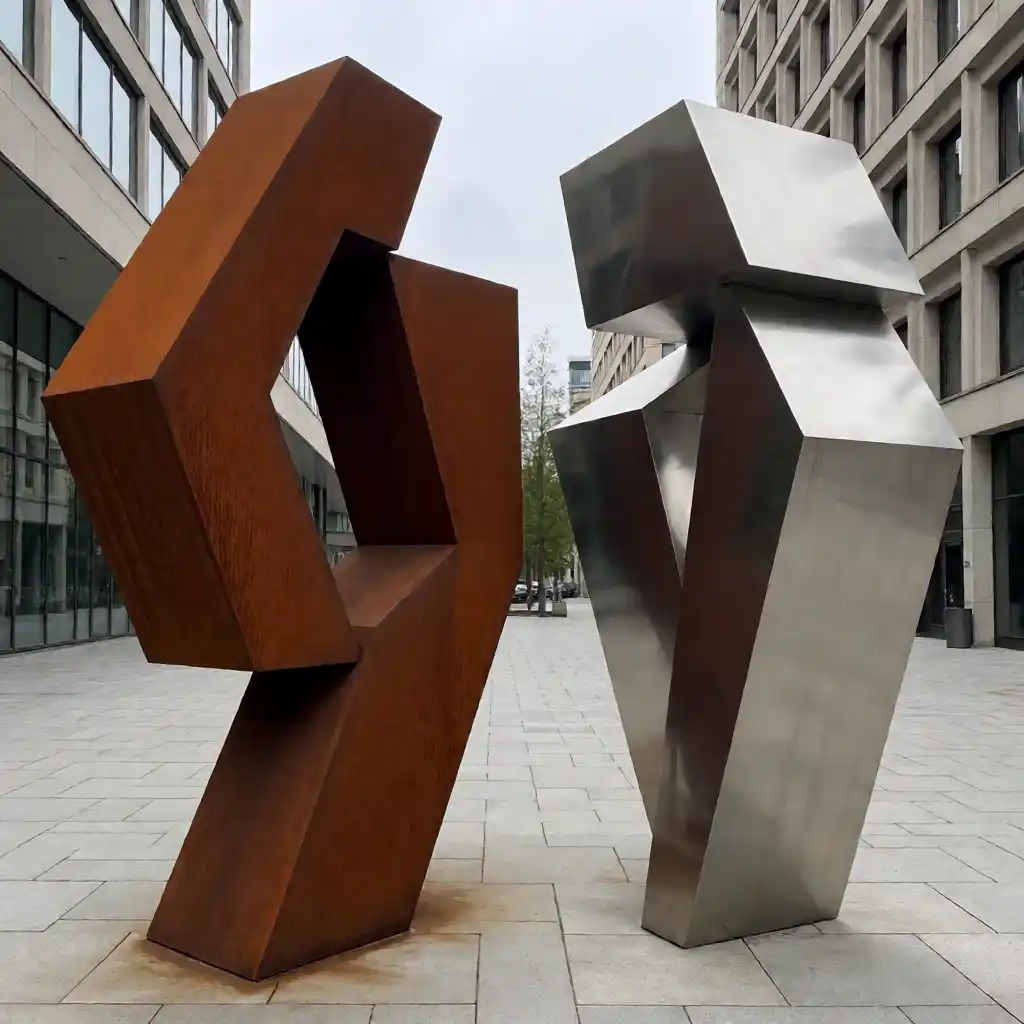
Stainless steel vs corten: the cost comparison, honestly
On raw material, corten plate runs noticeably cheaper than 304 stainless sheet of comparable thickness, and the gap is wide enough to move a budget line. Fabrication cost splits the same direction. Cutting, welding and grinding a corten piece does not ruin the finish, because the finish is rust — the weld discolouration weathers into the same patina. On a mirror-polished stainless surface, every weld and every heat-affected zone has to be dressed and re-polished back to uniformity, which is slow, skilled work.
That combination is why corten became the default for large civic commissions. When a municipality has a fixed budget and a monumental scale to cover, corten buys more square metres of sculpture per dollar, and the rusted aesthetic reads as public, durable and contemporary. It is a rational specification, not a compromise.
Stainless comes back to parity — and sometimes past it — in three predictable places. First, a polished or brushed finish, where the surface treatment is the product and customers are paying for reflection and precision. Second, a marine or heavily salted site, where 304 would pit and the job has to move to 316, so the comparison becomes corten versus 316 rather than corten versus 304. Third, and most often overlooked, a client who simply will not accept rust runoff — at which point the cheaper material creates a maintenance liability that erases the saving. For a wider view of how we run these comparisons across materials, our stainless steel vs bronze comparison follows the same reasoning.
How they weather over time
Cost decides the shortlist; weathering decides the winner over the life of the piece. The two materials look their worst and their best at completely different times, and the difference is most obvious in the first two years and again when winter salt arrives.
First two years
Corten is at its most troublesome here. Freshly installed weathering steel runs: rain carries iron oxide off the surface and deposits it wherever the water lands. It looks uneven for months and only gradually settles into the uniform patina clients picture. Stainless does the opposite — 304 arrives dull from the mill or the polishing shop and slowly brightens or holds its finish as the passive layer stabilises, with no discharge at all. Our geometric stainless sculpture in a park setting is a good example of a piece that looked settled from installation day.
Year five
By year five the corten patina has usually reached its characteristic dark orange-brown and stabilised, assuming the piece gets regular wet-dry cycles. Where it does not — under a canopy, in a desert, in a covered atrium — the layer stays patchy and keeps shedding. Stainless at year five looks essentially as it did at year one, apart from normal atmospheric soiling that a wash removes.
Winter with de-icing salt
This is where the split is sharpest. De-icing salt accelerates corten’s corrosion cycles, so runoff gets heavier and staining around the base worse in exactly the months when maintenance crews are least available. Salt is also the single strongest argument for specifying 316 instead of 304 stainless on any northern or coastal site with road salt nearby.
The runoff problem: corten stains everything around it
The most common corten complaint has nothing to do with the sculpture and everything to do with what surrounds it. Iron oxide carried in rainwater stains stone, concrete, glass, painted render and adjacent planting. On pale limestone paving the marks are obvious within one season; on glass they are permanent unless cleaned regularly, and on painted surfaces they can require repainting rather than washing. Nearby plantings suffer too — rust deposits on foliage and staining at the drip line.
None of this is unfixable, but all of it costs money and has to be designed in from the start.
- Drip trays and concealed gutters: capture runoff at the base and route it away from paving, retaining walls and planting beds.
- Sacrificial barrier strips: a replaceable band of stone or metal at the water line that takes the staining so the primary surface does not.
- Runoff-suppressing coatings: clear treatments applied to the corten that reduce oxide release while still allowing the patina to form. They need reapplication on a maintenance cycle.
- Cleaning the stained surfaces: the fallback. Stained stone and concrete can be cleaned, but this is a recurring cost that many clients never budget for.
Some clients reject corten on this basis alone, and they are not being unreasonable. A public plaza with white stone paving, glass facades and a maintenance contract measured in visits per month is a genuinely bad home for weathering steel — however good the render looked in the concept images.
Maintenance and upkeep
Both materials need maintenance. The useful comparison is effort, not existence — a common mistake is to present stainless as maintenance-free and corten as a lifetime commitment. Neither is quite true.
Corten needs the surface kept clean of debris and organic matter, especially leaves and soil at the base that hold moisture unevenly and cause patchy corrosion. If the patina layer is damaged — scratched back to bright metal, or drilled through — the affected area has to be allowed to re-weather, which is slow, or treated to blend it. Coatings, where specified, need reapplication on a known interval.
- Corten, annual: clear debris, inspect the base and water lines, check that drainage is still working.
- Corten, as required: treat damaged patina, reapply runoff-suppression coatings, clean stained adjacent surfaces.
- Stainless 304/316, annual: wash with fresh water and a mild detergent to remove atmospheric soiling; inspect for tea-staining around welds.
- Stainless, as required: re-passivate or re-polish high-visibility surfaces if a client wants the original finish restored after years of use.
In practice a stainless piece with a routine wash looks close to new for decades. A corten piece also lasts decades, but the maintenance attention is spread around it, not just on it.
Engineering and structural differences
The structural story follows directly from the corrosion behaviour. Corten has to corrode in order to protect itself, so there is a corrosion allowance built into the design: plate gauges are heavier to guarantee a sound section after decades of surface loss. That extra thickness is not free — it adds weight and requires heavier internal framing to carry it.
Stainless needs no corrosion allowance, so the material can be worked thinner for the same structural performance. That opens up finer, lighter forms: tight radii, thin edges, precise gaps. It also matters at height. On a tall piece, wind load governs the design far more than self-weight, and a lighter stainless section reduces both the lateral force the structure has to resist and the load the foundation has to carry. Thinner stainless can therefore be more efficient than thicker corten for the same visual mass — a point we cover in detail in our guide to wind loading on large stainless steel sculptures.
The trade-off is stiffness and fabrication complexity. Thin stainless plate moves more during welding and demands tighter quality control to avoid distortion. Corten’s heavier sections are more forgiving to fabricate and to erect, which is part of the reason it stays cost-competitive at monumental scale.
A decision table
The table below summarises the comparison at the level we use with clients. It is deliberately balanced: corten wins several rows outright, and the right column for your project may well be one of them.
| Material | Upfront cost | Weathering look | Runoff risk | Maintenance | Best sites | Worst sites | Typical use |
|---|---|---|---|---|---|---|---|
| Stainless 304 | Higher material cost; polishing labour dominates | Bright, stable, holds finish; no patina change | None | Annual wash; re-polish only if required | Inland plazas, parks, campuses, indoor atria | Coastline, pool decks, salt-spray zones | Landmarks, mirror-finish abstracts, corporate entrances |
| Stainless 316 | Highest material cost, typically 20–30% above 304 | Bright, stable, resistant to chlorides | None | Annual wash with fresh water; occasional passivation | Coastal promenades, marine sites, winter-salted cities, pools | Budget-driven civic work | Seafront sculpture, fountains, waterfront civic art |
| Corten (SA 524 / 409) | Lowest material and fabrication cost | Develops deep rust-orange patina over 1–2 years | High — stains stone, concrete, glass and paint | Annual debris clearing plus runoff management | Civic sites with generous setbacks, industrial and heritage contexts, rough landscaping | Glass-and-white-stone plazas, roof terraces, indoor spaces, seating edges | Large monumental work, wayfinding markers, architectural screens |
When to choose corten, and when not to
Strip away the marketing and the decision usually comes down to three inputs: budget, aesthetic direction and what is physically next to the piece.
- Corten wins when the budget is civic and fixed and you need maximum sculptural coverage per dollar.
- Corten wins when the work is large-scale and monumental, where heavier sections are an advantage rather than a cost.
- Corten wins when the brief genuinely calls for an industrial, rusted or weathered aesthetic — that is what the material does best.
- Corten wins when the surroundings are tolerant: gravel, rough planting, generous setbacks and no pale paving or glass within splash reach.
- Stainless wins when the site is coastal or salt-exposed, where 316 avoids pitting entirely.
- Stainless wins when pools or water features are involved and chlorides are in the air.
- Stainless wins when the plaza or facade is stone, glass or pale concrete that cannot be allowed to stain.
- Stainless wins when the client has specified a modern polished or brushed look, or the piece is indoors.
- Stainless wins when tight tolerances and fine detail are part of the design intent.
Both directions have live references on our site. The corten public art entryway shows how well weathering steel reads at an entrance scale, while the commercial plaza landmark is a stainless piece in a setting where runoff staining would have been unacceptable.
How to specify it so nothing surprises you
Most corten disappointments are specification failures, not material failures. Work through this list before the order is placed.
- Name the grade and the standard. Write “SA 524” or “409-type weathering steel” into the specification for corten, and “304” or “316” for stainless. “Stainless steel” alone is not a specification, and neither is “corten” as a brand shorthand.
- Decide whether the patina is pre-formed or weathered on site. Pre-weathering at the yard gives the client the finished colour before installation; weathering on site takes one to two years and produces visible running during that period. State which one you are buying.
- State whether a runoff treatment is required. If paving, glass or painted surfaces are within splash reach, specify the drip tray, barrier strip or suppression coating explicitly, and identify who installs and maintains each.
- Get a written surface-protection clause for adjacent materials. This allocates responsibility for cleaning or replacing stained stone, glass and paint, and it is the single clause that prevents most post-installation disputes.
- Sign an honest maintenance plan before install. Annual debris clearing and inspection for corten; annual washing for stainless; plus the specific interval for any coating that was applied.
Have a project in mind?
If you are weighing stainless steel vs corten for a specific site, the fastest way to a clear answer is to send us the location, the scale and the surfaces nearby — those three facts usually settle it. We will tell you honestly which material we would specify, including when the answer is the cheaper one, and what the runoff and maintenance implications are before you commit. Request a quote and we will come back with a material recommendation and a cost range for your project.
More from the Workshop
Have a Project in Mind?
Send your brief and get a free, honest quote within 24 hours — no obligation.
Request a Quote