
Stainless Steel vs Bronze Sculpture: Which Should You Choose?
September 16, 2026
Stainless Steel vs Bronze: The Short Version
\n
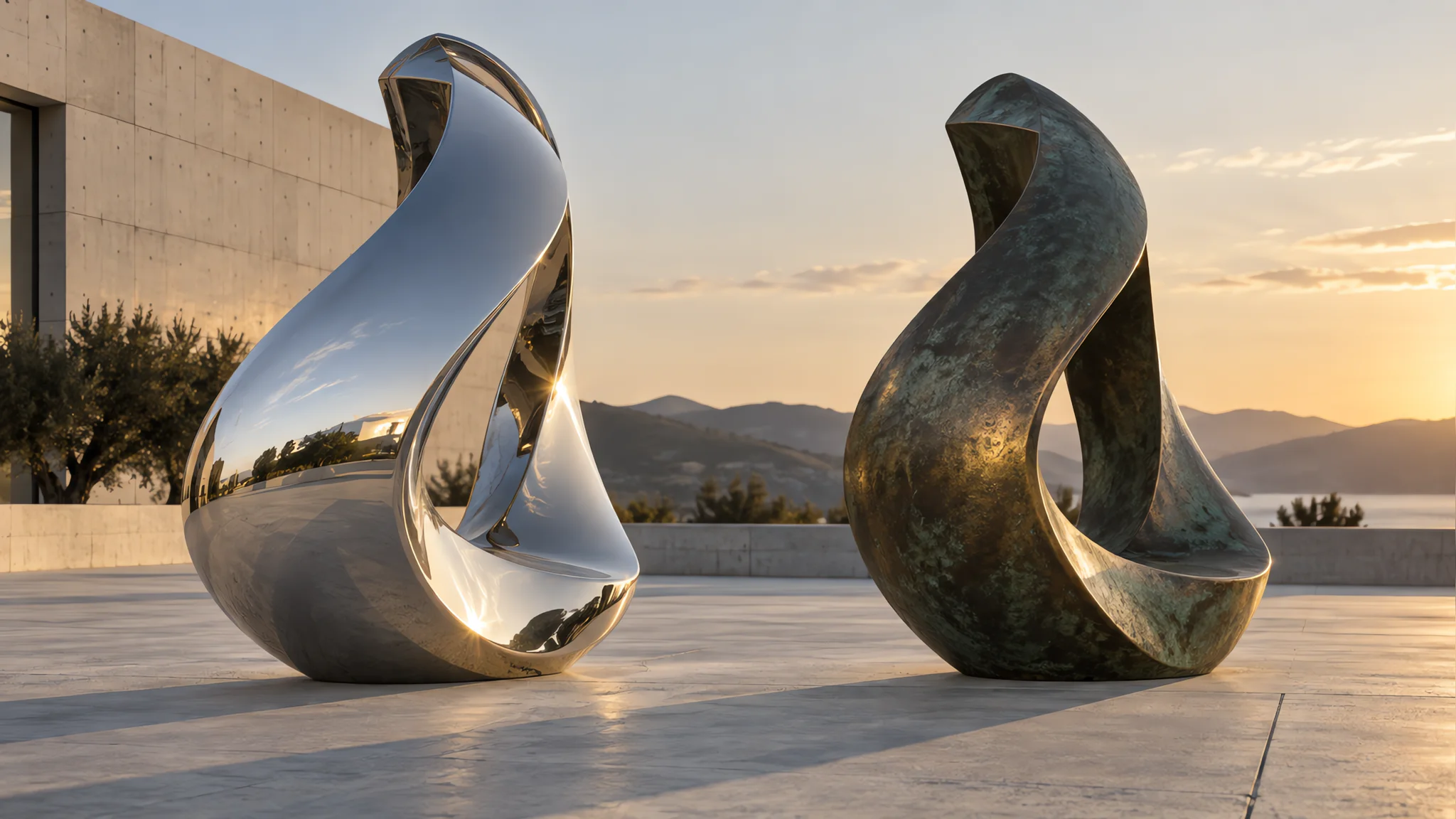
Both materials make exceptional outdoor sculptures, but they serve very different briefs. Stainless steel reads as architecture — clean, reflective and precise. Bronze reads as craft — warm, traditional and human. Choosing between them comes down to three things: the environment, the maintenance you are willing to accept, and the look you want.
\n
For a coastal hotel courtyard, a corporate plaza or a public park with a long maintenance window, the honest answer is usually different — and the difference is rarely about price. This article walks through the four things that genuinely decide it, and finishes with a decision table you can take straight into a design meeting.
\n\n
\n\n
Environment: Salt, Climate and Site Conditions
\n
Coastal and marine sites. Stainless steel, especially 316 marine grade, wins outright in salt and chlorinated settings such as pools, seafronts and water features. Bronze is durable, but a coastal bronze piece will develop a fast, sometimes unpredictable patina that many hospitality clients dislike — the green-black surface shifts with rainfall and airflow, and it bleeds onto light paving and adjacent finishes over time.
\n
Cold-climate sites. Both materials are structurally sound well below freezing, but bronze conducts heat differently and can feel uncomfortably sharp to the touch in winter — a genuine concern for interactive or memorial pieces where people lean, sit or lay flowers. Stainless stays closer to ambient temperature and is the safer spec for anything that will be touched daily.
\n
High-wind urban plazas. Here the material is less important than the structural engineering behind it — see our wind-loading engineering guide. Bronze’s higher density actually helps: a bronze plinth is naturally heavier for its volume, which reduces the ballast you need on a wind-exposed platform. Stainless needs more careful plinth and base design to match that weight advantage.
\n\n
Maintenance: What Year Five Looks Like
\n
This is where the two materials diverge most sharply, and it is the factor most clients underestimate in the first year.
\n
Stainless steel is essentially low-maintenance. A rinse with clean water keeps mirror finishes bright. 316 in a poolside or coastal setting needs the same; there is nothing to wax, seal or refresh. The one cost is periodic inspection of welds and fixings on larger pieces, which we schedule with every commission — see how a stainless public-art piece holds up in our public plaza landmark project.
\n
Bronze develops a protective patina and needs occasional waxing. Left to itself, raw bronze in an outdoor setting moves toward a dark green-black surface within two to four years, and that colour is stable and self-protecting. If the brief wants that authentic aged look, bronze is the cheaper long-term choice — it does not need touch-ups. If the brief wants a stable, warm gold-brown colour that is held in place, the piece needs a wax or lacquer coating renewed every few years, and that maintenance has to be on someone’s calendar.
\n
Corten — the third option, worth a line here since it often enters this same conversation. Corten (weathering steel) requires no maintenance at all, which is its main appeal, but it weeps rust-water for the first two to three years of its outdoor life and will stain light-coloured paving, planters and building finishes. If the site’s palette is bright or reflective, that is a deal-breaker on its own.
\n\n
The Look: Modern Architecture or Timeless Craft
\n
Stainless is clean, reflective and definitively modern. A mirror-polished form photographs beautifully and reads as high-design in a corporate or hospitality setting. Its one limitation: it reflects whatever is around it, which means it is only as strong as the surroundings. A beautiful piece in a cluttered lot can look ordinary — the site has to earn it.
\n
Bronze is warm, traditional and human. It holds its own colour regardless of what is behind it, which makes it the stronger choice in settings with busy backgrounds — parks, institutional campuses, residential neighbourhoods where the background is trees and buildings rather than a designed vista. It also photographs differently: bronze’s patina gives depth and warmth to an image that stainless’s reflection sometimes flattens.
\n
Our cast bronze park figure project shows the warm, human scale bronze holds up to, and our commercial plaza landmark shows how a polished stainless form anchors a hard, modern public space.
\n\n
Cost: Upfront vs Lifetime
\n
The most honest cost answer is that bronze and stainless are broadly similar in material and fabrication cost for a piece of the same scale — neither is meaningfully cheaper upfront. The gap opens over time: a stainless piece you rinse once a year will likely still look the same in twenty years that it does on day one. A bronze piece held at a stable colour needs periodic recoating; a bronze piece left to age will not look the same in year five as it did on day one — but that is the point, and it costs nothing.
\n
Where cost genuinely splits: very large abstract forms in stainless are more forgiving of engineering shortcuts than bronze, because bronze’s cast nature has fewer second chances. A badly conceived bronze piece is expensive to fix; a stainless piece can often be repaired, re-welded and re-polished.
\n\n
A Decision Table for Your Brief
\n
| Consideration | Stainless Steel | Bronze |
|---|---|---|
| Best environment | Coastal, salt, chlorinated, poolside | Interior-adjacent, park, residential, institutional |
| Long-term colour | Stable — brightens or dulls slightly, never green | Moves — darkens to green-black, or holds with recoating |
| Maintenance load | Rinse; inspect fixings | Wax every few years, or accept the patina |
| Visual character | Modern, architectural, precise | Warm, traditional, human |
| Weight advantage | Lighter for its strength; more plinth engineering | Denser; naturally heavier base, less ballast needed |
| Best suited to | Hotels, corporate, public landmarks, water features | Memoirs, parks, residential, institutions |
\n\n
What We Build in Each
\n
Stainless commissions are our default for hotels, corporate plazas and public landmarks. We work primarily in 316 for anything coastal or pool-adjacent, 304 for inland sites, and we detail the plinth and weld schedule the same as we detail the form itself — the structure is part of the piece. Our airport landmark sculpture project and coastal stainless commission are two ends of that range.
\n
Bronze commissions come to us most often as memorials, park figures and institutional markers where the brief is explicitly about permanence and warmth rather than polish. We cast in bronze against the same engineering discipline — our bronze memorial project and cast bronze horse project show the two distinct tonalities we can hold: a bright, fresh-cast finish or a deliberate aged patina.
\n
If the brief sits in the middle — a piece that should read as designed architecture today and settle into a landscape over a decade — we will tell you on the call, free, which of the two materials gets you there. Send us the site, the intended use and any adjacent finishes you are worried about, and we will come back with the material call and the reason, within 24 hours.
\n
More from the Workshop
Have a Project in Mind?
Send your brief and get a free, honest quote within 24 hours — no obligation.
Request a Quote