
Shipping a Stainless Steel Sculpture Internationally: Crating, Customs and Install
September 18, 2026
The uncomfortable truth about shipping custom sculpture is that for two to six weeks you cannot see it. A welded figure leaves the workshop wrapped in foam and screwed into a crate, and the next time anyone inspects the mirror finish it is on another continent. You cannot watch the crane, you cannot check the strap, and you cannot tell the dock worker that the top edge scratches if the crate is dragged face-down. By the time the photographs arrive, the decisions that mattered were made months earlier, in a packing list and an insurance clause you signed without reading twice. This article is about the crate and the paperwork, not the sculpture — because that is where international sculpture shipping is actually won or lost.
Why shipping custom sculpture is different from furniture shipping
Freight companies move a great deal of furniture, and their default assumptions are built for it: flat panels, stackable boxes, replaceable units, and a scratch nobody will notice under a table. A stainless steel sculpture breaks every one of those assumptions, and the moment you accept the furniture playbook you have accepted the furniture risk.
- Irregular dimensions. A sculpture is not a box. Arms, wings and cantilevers occupy space cargo planners expect to be empty, so the piece cannot be stacked, palletised or nested against anything else in the container.
- Single-piece risk. There is no second unit on the shelf. If the head cracks or the base tears loose, nobody ships a replacement next week — the commission restarts at the fabrication stage.
- A surface that turns on the way. A polished or brushed stainless finish is a damage amplifier: a mark invisible on a painted steel beam reads as a bruise on a reflective surface, measured by reflected light rather than direct inspection.
- The sculpture often cannot be re-packed. The crate that left the workshop holds its geometry. Once a piece is pulled out at a port for inspection, the foam blocks rarely seat correctly again, and a re-crated sculpture travels worse than it did the first time.
Because the buyer’s hands are tied during transit, every scrap of leverage sits in documents written beforehand: the crate specification, the declared value, the named receiver at the port, and the instruction to photograph on arrival. The destination shapes the route as much as distance does — browsing our sculpture applications by setting shows whether a piece is travelling to a plaza, a fountain, a facade or an interior, and each destination implies a different truck, crane and access plan. The same upstream logic governs fabrication, as our sculpture commissioning process sets out.
Road, air or sea: choosing the lane for shipping custom sculpture
The instinct is to pick the lane by distance. The correct method is to pick it by dimension and finish first, then by deadline, and only then by distance. A 900 kg polished sphere and a 40 kg wall relief can leave the same workshop and travel by completely different means.
Road
Inland haulage and short cross-border runs are the lowest-risk lane for the surface, because the sculpture never leaves the crate for a modal transfer and rarely sits in an open yard. The trade-off is practicality: anything above roughly 2.5 m wide needs permits, escort vehicles and night-only movement in many jurisdictions. Road is the right answer for domestic installation and for the first and last legs of every other lane.
Air freight
Air is fast, expensive and dimensionally unforgiving. Aircraft pallets impose hard height and width limits, and the piece is transferred by machinery the shipper does not control. Air makes sense for small and mid-scale pieces with a fixed unveiling date, or for a replacement element needed in days. It rarely makes sense above a few hundred kilograms, and it is where unprotected polished surfaces suffer most, because air cargo handling is fast by design.
Sea freight
Sea is the default for large pieces: a full container load gives you a sealed, dry space nobody re-stacks. The risks are humidity, duration and condensation inside the container. Anything over roughly 2.5 m needs a flat rack or open-top container, which removes the roof but keeps the crate bolted down. Sea is slowest — four to eight weeks door to door on many lanes — and it is the lane where desiccant, ventilation and moisture barriers stop being optional.
Two technical facts compress the decision further. Dimensional weight rather than physical weight often governs cost and lane feasibility, which is why the structural realities in our guide to wind loading on large stainless sculptures also drive freight planning. And the material changes how much visible marking you can tolerate: cast bronze ages its marks into a patina, as we explain in stainless steel versus bronze, while stainless keeps every scratch visible.
Crating: where most surface damage actually happens
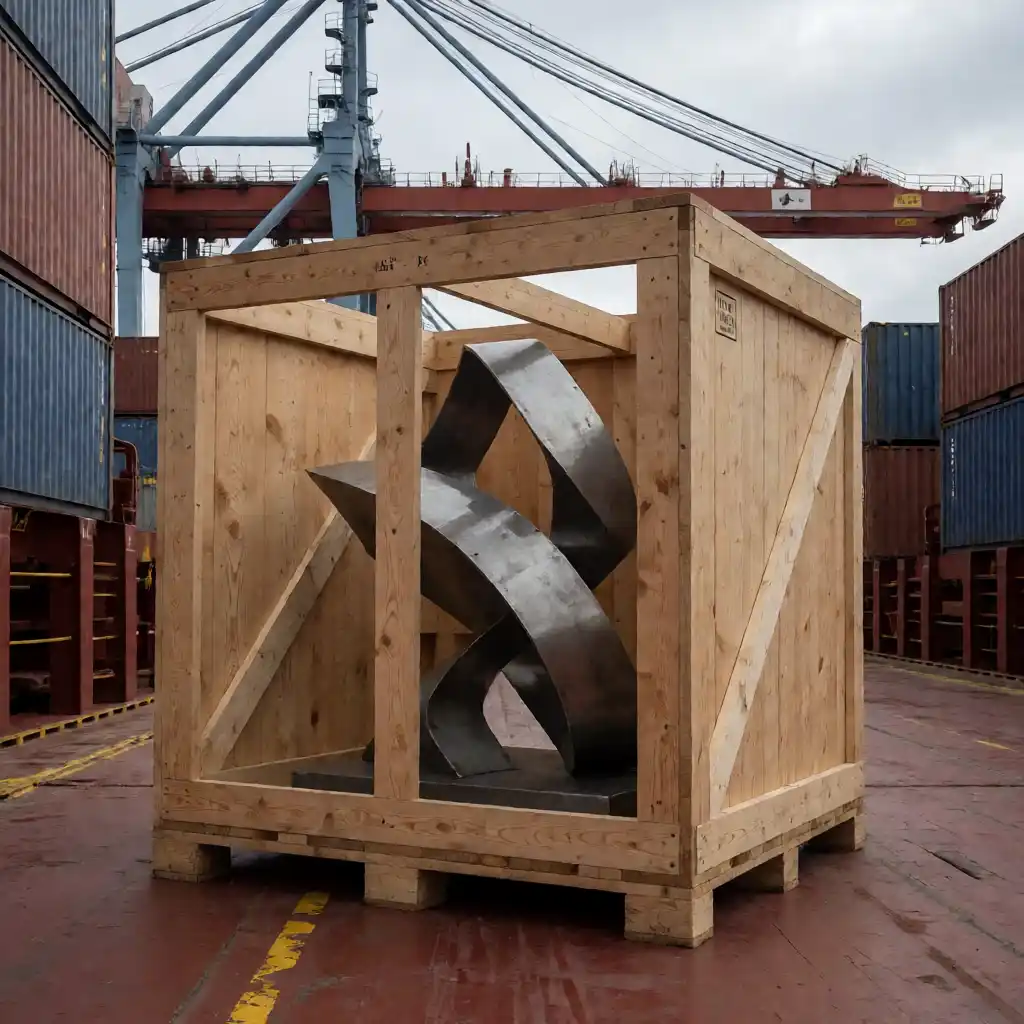
At this stage the crate is the product. The sculpture is a passenger, and its finish survives or fails on decisions invisible from outside the box. A crate that is right saves the finish; one that is wrong costs more than the sculpture, because remediation means re-polishing on site or flying a fabricator out at short notice.
- Internal protection against the finish. Mirror or brushed surfaces get acid-free foam, felt or clean moving blankets applied directly, taped to the sculpture and never to the finish. No strapping runs bare across a polished face.
- A rigid internal frame. Blocks, saddles and brackets are built to the actual geometry so the piece cannot shift, rotate or rock. Movement of a few centimetres over four thousand kilometres produces most deep scratches.
- Ventilation and desiccant for sea. A sealed crate on a ship sweats on the inside. Vent ports, moisture barriers and calculated desiccant keep condensation off the steel and prevent the white blooming that ruins a polished surface.
- Corner protection. External timber battening on all eight corners absorbs forklift and container-edge impacts so a shock is spent on the crate rather than transferred to the sculpture.
- A loadable base. The crate must be liftable from underneath, with skids and a forklift pocket that let machinery handle it without touching the sculpture or relying on the sides for support.
Ask for photographs of the assembled crate before it is closed, and for the external dimensions and gross weight in writing. Those two numbers feed every freight quote and every customs document that follows.
Freight insurance, and what it will and will not cover
Freight insurance is not a formality, and the difference between a policy that pays and one that argues is usually a single sentence. Most sculpture losses are finish claims, not total losses, and insurers treat them with far more suspicion.
- Insure at declared value, not a percentage of invoice. The cheap-looking option covers a fraction of the invoice value. It reads like a discount until the claim settles at that fraction, and the shortfall comes out of the buyer’s pocket.
- All-Risks is the baseline. Named-peril coverage excludes whatever nobody thought to name, which in sculpture logistics is usually handling damage.
- The claim window is short. Visible damage claims typically must be opened within 24 to 48 hours of receipt, with photographs taken by the receiver at the dock — before the crate is opened further, before the sculpture is moved, and before anyone signs a clean delivery note.
- Inadequate packing and pre-existing conditions are standard refusals. Insurers decline claims where the packing is judged insufficient for the declared value, where the loss is described as cosmetic wear, or where the receiver signed without noting damage.
Read the exclusions page before the crate is loaded. The most valuable line in the policy is the instruction that the receiver photographs the crate and the sculpture on arrival and reports any visible mark immediately.
Customs clearance for artwork and metal sculpture
Customs is where a well-run shipment turns into a two-week hold, and where a hurried classification decision costs the buyer real money. Everything here should be agreed in writing with the importer before the sculpture moves.
HS classification
A stainless steel sculpture is a strong candidate for the 9704 art classification rather than a generic article-of-metal heading. The distinction is not academic: art categories frequently attract zero or reduced duty, while generic metal classifications can attract meaningful percentage rates. The sculpture has to genuinely qualify as an original work, which is why authorship paperwork matters. A wrong HS code costs money at the port and delays the whole installation.
Certificates of origin
Origin documentation supports preferential duty treatment under free trade agreements and proves where the piece was fabricated. It must match the invoice, the packing list and the HS code exactly.
Customs value documentation
Customs assesses goods on value, not weight. The commercial invoice, the contract and, where relevant, a statement of value or certificate of authorship must tell one consistent story. Inconsistency between documents is the most common trigger for a physical inspection.
Import VAT and duty by region
Duty rates and import VAT vary widely by destination, and VAT is normally payable by the importer at the point of entry even where duty is zero. Confirm the landed cost before shipping, and never assume the zero-duty outcome that applies in another country applies here.
Documents that must travel with the sculpture
Documents travel with the crate, not in an email nobody opens at the port. A missing document is a week of delay, demurrage charges and, in the worst case, a sculpture sitting in the open while someone chases a signature.
- Commercial invoice — description, quantity, unit value, currency, Incoterm and the names of both parties.
- Packing list — exact external dimensions, gross and net weight, crate count and contents, itemised per crate.
- Certificate of origin — issued by the competent authority for the manufacturing country.
- Insurance certificate — naming the shipment, the declared value and the consignee as beneficiary.
- Engineering or weight certificate — lifting points, centre of gravity and total mass, which the receiving crane crew needs before they rig anything.
- Certificate of authorship or statement of value — frequently required to support art-category classification.
The install day: the last mile that decides everything
A sculpture can arrive in perfect condition and still be ruined in the final two hours. Crane day is the highest-consequence, lowest-supervision moment of the project, and it rewards an hour of planning far more than improvisation on the day.
- Access survey before the truck arrives. Measure the gate, the ramp, the overhead cables and the turning circle, and confirm the crane’s outrigger spread and the surface it will stand on.
- Protection during the lift. Slings padded, no bare chain on a polished surface, no wrap that can slip, and a tag line so the piece never swings into a wall.
- Base setting and alignment. Anchor bolts, levelling, orientation to the main approach sightline, and drainage checked on water features before the crane is released.
- A final walk-around with the receiver. Photograph every face and sign a joint condition report while the crane and crew are still on site, not the following morning.
Large public work shows the pattern clearly: a landmark delivered to an airport gateway installation faces night-only lifting windows and security escort rules, while a commercial plaza delivery has to work around trading tenants and live footfall. Both are normal sculpture installations, and both are won on the day’s rehearsal, not on the crane.
A shipping cost and timeline table
The ranges below are typical for a mid to large stainless steel commission of one to three cubic metres and several hundred kilograms. Treat them as planning ranges, not quotes.
| Lane | Typical transit | Surface risk | Insurance expectation | Biggest delay risk |
|---|---|---|---|---|
| Inland road | 1–7 days | Low | Standard named-peril cover is usually enough | Oversize permits and escort approvals |
| Cross-border road | 3–10 days | Low to moderate | Add border dwell cover | Customs inspection at the land border |
| Air freight | 3–7 days door to door | Moderate to high if unprotected | All-Risks at declared value, tight claim window | Dimensional limits, re-palletising and handling damage |
| Sea freight (FCL) | 25–55 days door to door | Low in a sealed container if crated well | All-Risks plus humidity and condensation clauses | Port congestion, HS code holds and clearance paperwork |
A pre-shipment checklist
Work through this list before the crate is closed. Every item is cheap to satisfy now and expensive to fix afterwards.
- Photograph the surface condition from all sides, with a dated file, before the sculpture is wrapped.
- Inspect the assembled crate against the specification and photograph the internal blocking.
- Bind insurance at declared value, with All-Risks wording and the exclusions read.
- Agree the HS code in writing with the importer and confirm duty and VAT treatment.
- Complete the customs value documentation so invoice, packing list and origin certificate agree exactly.
- Confirm the receiver’s access, crane booking and lifting window in writing, not by phone call.
- Name a single contact at the receiving port who is authorised to accept and to open a claim.
- Write the photograph-and-report instruction into the contract and into the delivery note the receiver signs.
Have a project in mind?
If you are planning shipping custom sculpture across a border, the cheapest hour you will ever spend is the one before the crate is closed. Send us the drawing, the destination and the deadline, and we will come back with a crate specification, a recommended lane and the documentation list for your importing country — so the only surprise on arrival is how good the finish looks. Request a quote for your stainless steel sculpture project and start the paperwork early.
More from the Workshop

Have a Project in Mind?
Send your brief and get a free, honest quote within 24 hours — no obligation.
Request a Quote