
How Much Does a Stainless Steel Sculpture Cost in 2026?
September 18, 2026
Almost every enquiry that lands in our workshop inbox opens the same way: “before we go any further, what does a stainless steel sculpture cost?” It is a fair question, and an unusually hard one. A 600 mm garden piece and a 9 m airport landmark are both “stainless steel sculptures,” yet they sit two orders of magnitude apart in price. Material is only about a quarter of the answer. The rest is geometry, finish, engineering, freight and the crane that lifts it over the fence. This guide gives you the 2026 ballpark ranges we quote from, the four variables that swing them most, and the six pieces of information that turn a range into a firm number.
How much does a stainless steel sculpture cost in 2026?
Stainless steel sculpture cost in 2026 breaks down into four broad bands. These are ballpark ranges from our own workshop, based on completed projects through 2025 and current mill pricing — they are reference points, not quotations. Every project is priced on its own drawings, and a firm number only exists once the brief is fixed.
- Small decorative (under 1 m): USD 2,500–8,000. Tabletop and garden-scale pieces, single form, simple plate construction. At this size the sculpture is essentially a fabrication job with a nice finish.
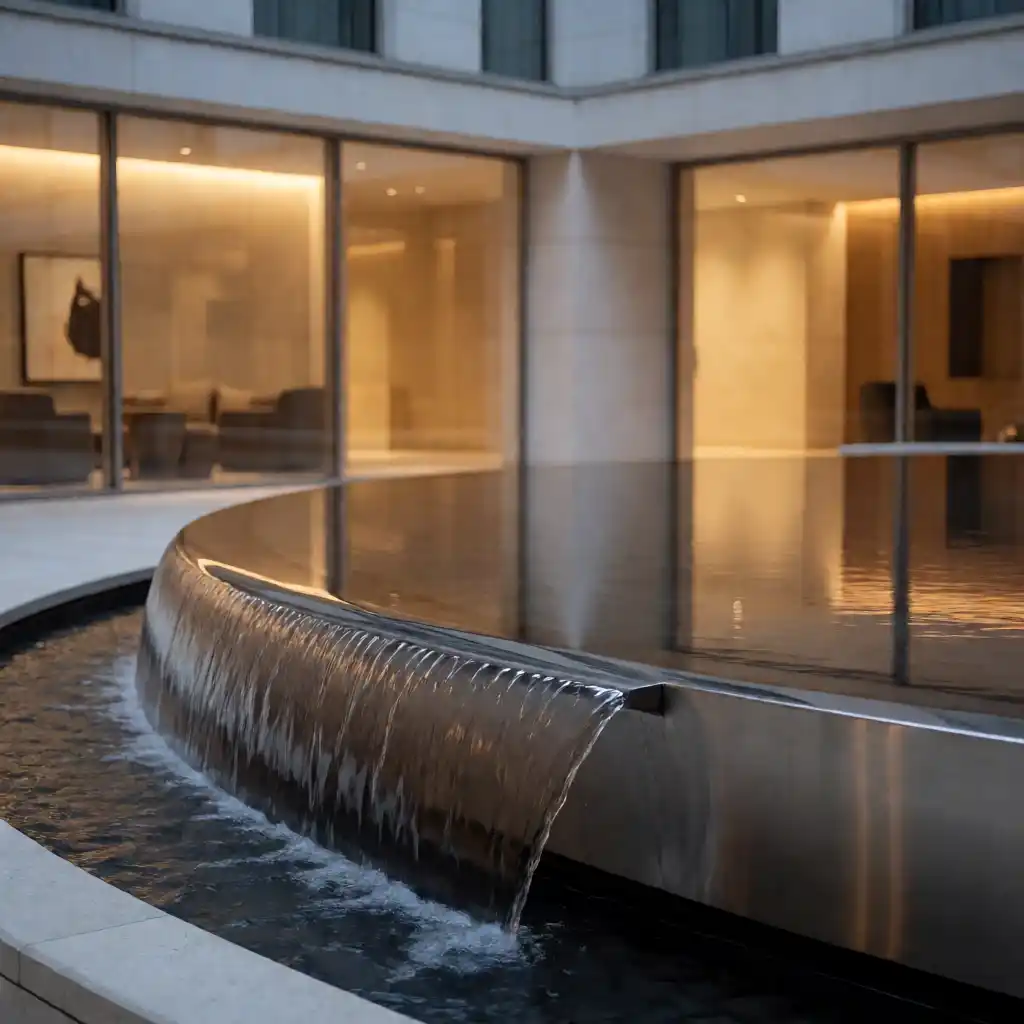
- Mid-size feature (1–3 m): USD 8,000–35,000. The most common brief — a plaza centrepiece, a hotel forecourt, a memorial. Requires an internal armature, a designed base and lifting points. A good reference is our mirror-polished plaza fountain, which sits in this band.
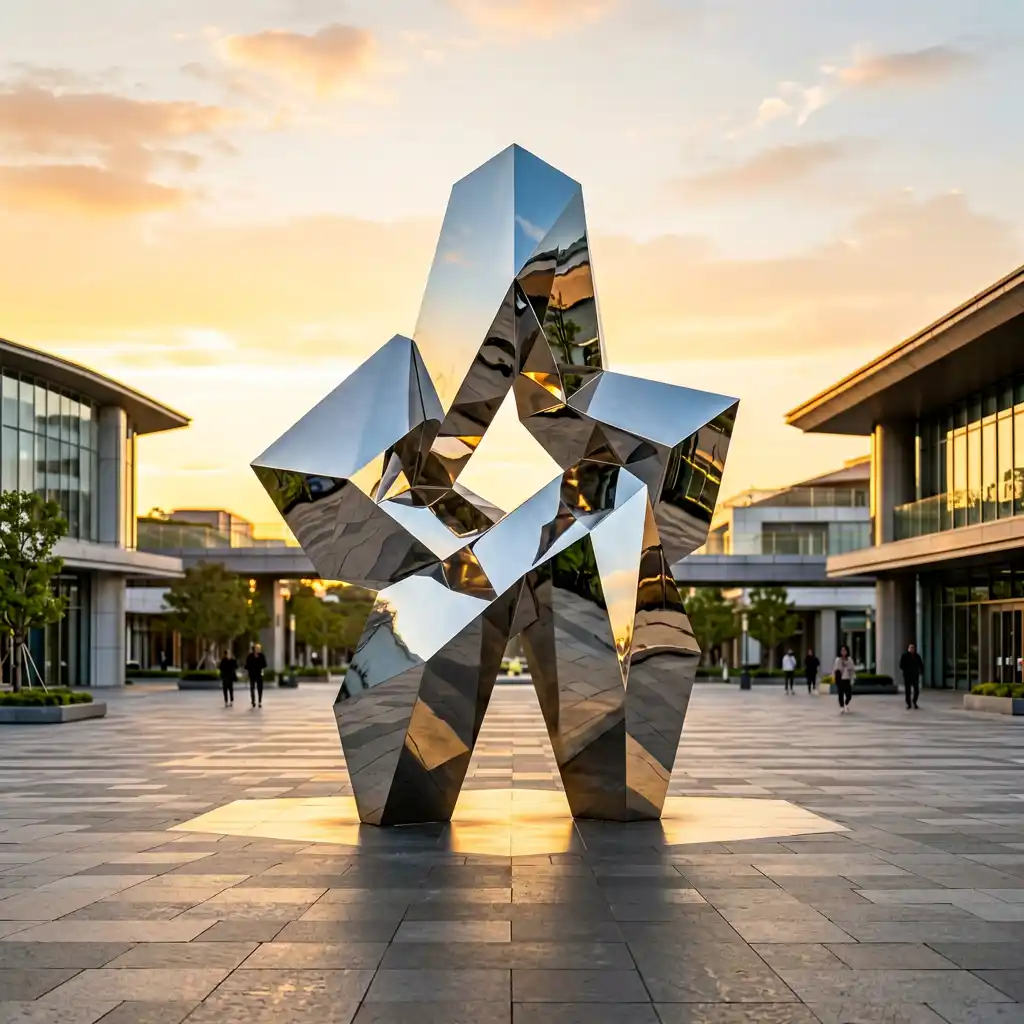
- Large architectural (3–6 m): USD 35,000–120,000. Engineered structures with wind analysis, bolted site joints and a foundation interface. Freight becomes a real line item. See our airport landmark installation for what this band produces.
- Monumental landmark (over 6 m): USD 120,000+. Bespoke engineering, staged fabrication, multiple site deliveries, certified welding and inspection. Some are seven figures.
Two rules of thumb help. First, cost scales faster than height: doubling a form’s height roughly cubes the steel volume if you scale it proportionally, and polishing labour scales with surface area, not length. Second, the spread inside each band is wide. A 2 m brushed piece in 304 with a simple ground pad can come in at USD 9,000; the same footprint in mirror-polished 316 on a rooftop, with wind certification and a crane lift, can reach USD 30,000. That gap is the entire subject of the next section.
The four factors that move the number
When a quote surprises a client, it is almost always one of four things. Understand these and you can predict roughly where your project will land before you ever ask for a price.
1. Size and volume of steel
Price follows the volume of steel and the hours of labour, not the silhouette. A tall, thin form may use less material than a compact, bulky one. Hollow fabrications save weight and cost, but only where the geometry allows — a tight compound curve may demand more forming hours than a simple box of twice the volume.
2. Finish
Finish is the single most under-estimated cost driver. A brushed (satin) finish is produced with a linear abrasive pass and is relatively quick. A true mirror polish requires progressive grit stages up to fine compound, often hand-worked into curves and welds, and can add 30–60% to fabrication labour. The larger the surface area and the more complex the curvature, the wider that premium becomes.
3. Structural engineering
Anything outdoors is a structure, not a statue. Wind load governs the plate thickness, the size of the internal spine, the number and pattern of anchor bolts, and the design of the base. A coastal or exposed site can push loads up sharply. For a detailed treatment, see our guide to wind loading on large stainless steel sculptures. Engineering and its certification typically account for 8–15% of a large project’s budget and are not optional.
4. Logistics and installation
Freight, cranes, permits and site access are frequently 10–20% of the total. A sculpture that fits a standard container is cheap to move; one that needs a low-loader, an escort and a night-time road closure is not. If the crane has to be parked three streets away and the piece carried in, that shows up in the price. Always tell the fabricator how close a truck can get.
304 vs 316 stainless steel: which grade, and the cost difference
The two grades that dominate architectural sculpture are 304 and 316. Both are austenitic, non-magnetic in the annealed state, and weld well. The difference is molybdenum: 316 contains 2–3% molybdenum, which dramatically improves resistance to chlorides — salt spray, coastal air, de-icing road spray and swimming-pool atmospheres. As a rule, 316 runs roughly 20–40% above 304 on the mill price of the sheet, which translates to a smaller but still meaningful premium on the finished sculpture, since steel is only part of the cost.
Which should you specify?
- Choose 304 for inland sites, sheltered courtyards, indoor installations and anywhere more than roughly 10 km from salt water.
- Choose 316 for coastal and marine sites, rooftop and elevated installations, fountains and water features, roadsides with winter salting, and any piece in an industrial or high-pollution atmosphere.
- Choose 316L (low-carbon) where heavy welding is required in thick sections, to reduce the risk of weld sensitisation.
The trap is specifying 304 to save budget on a coastal project. The saving is real and immediate; the cost is tea-staining and pitting that appears within two to five years and cannot be polished out without removing material. We have written a full comparison of chemistry, corrosion behaviour and life-cycle cost — see 316 vs 304 stainless steel for sculpture. Our default recommendation for any outdoor piece within sight of the sea is 316, without exception.
The real cost of “cheap” sculpture
It is entirely possible to buy a stainless steel sculpture for half our price. It is also possible to buy one that has to be replaced in four years. The difference rarely shows up on the drawing — it hides in metal thickness, weld preparation, passivation and base design. These are the failure modes we are most often called in to repair.
- Hairline pitting and tea-staining. Usually the wrong grade for the environment, or a finish that was never properly passivated after fabrication. Free iron contamination left on the surface becomes rust spots within a season.
- A loose base. Under-engineered anchorage or a base plate too thin to distribute wind load. The sculpture begins to rock, then the welds crack, then the piece becomes a safety issue and must be taken down.
- A finish that dulls in year two. Cheap polishing leaves directional scratches that trap dirt. The mirror look fades to a hazy grey and cannot be restored by cleaning alone.
- Weld discolouration bleeding through. Heat tint not removed before finishing re-appears as dark ghost lines once the piece is outdoors.
The arithmetic of re-doing a sculpture is brutal: removal, disposal of the old piece, a second full fabrication, and a second installation — plus the reputational cost of a landmark that rusted. Total cost of ownership, not sticker price, is the right comparison. It is also worth remembering that stainless steel is not always the cheapest metal up front; cast bronze is often less expensive for smaller, highly detailed work, though it has its own life-cycle profile. We compare the two in stainless steel vs bronze for outdoor sculpture.
A stainless steel sculpture cost comparison table
The table below consolidates the four bands into something you can hold against a real brief. Treat the ranges as indicative; the “Notes” column is where the real variability sits.
| Category | Typical height | Steel volume | Indicative range (USD) | Typical grade | Notes |
|---|---|---|---|---|---|
| Small decorative | 0.3–1.0 m | 15–60 kg | 2,500–8,000 | 304 | Tabletop to garden; simple plate forms; indoor or sheltered |
| Mid-size feature | 1.0–3.0 m | 80–350 kg | 8,000–35,000 | 304 or 316 | Plaza, forecourt, memorial; armature and designed base required |
| Large architectural | 3.0–6.0 m | 400–1,500 kg | 35,000–120,000 | 316 / 316L | Wind certification, bolted site joints, freight is a major line |
| Monumental landmark | 6 m+ | 1,500 kg+ | 120,000+ | 316 / 316L | Bespoke engineering, staged fabrication, certified inspection |
Read the volume column as carefully as the price column. A mid-size piece at the top of its weight range is approaching a large piece in cost, even if the height suggests otherwise. Bulky, closed, heavy-wall geometry is expensive regardless of how tall it stands.
A second comparison: mirror-polished vs brushed finish
Finish choice affects price, maintenance and how the sculpture reads from a distance. Mirror polish is dramatic and photogenic; brushed satin is quieter and far more forgiving. Neither is “better” — the right answer depends on the site and the maintenance regime the owner will actually follow.
| Attribute | Mirror-polished | Brushed (satin) |
|---|---|---|
| Cost premium vs mill finish | High — 30–60% added fabrication labour | Moderate — single directional pass |
| Durability in exposed sites | Good in 316; haze and micro-scratches show | Excellent — scratches blend into the grain |
| Visibility of fingerprints | High at hand height; less so above 2 m | Low |
| Best sites | Sheltered plazas, lobbies, water features, focal points viewed close up | Coastal fronts, high-traffic areas, rooftops, industrial surroundings |
| Cleaning regime | Regular, with correct cloth to avoid swirl marks | Occasional; tolerant of neglect |
Two practical points. First, on anything above about 4 m the visual difference between a good brushed finish and a mirror finish shrinks, because the viewer is far away and the reflection is dominated by sky. Second, and more importantly, a mirror finish on an exposed coastal site is a maintenance contract, not a one-off purchase. Where wind exposure is significant, engineering decisions and finish decisions interact — see the wind loading guide for how the two are resolved together.
What actually drives stainless steel sculpture cost, by phase
Clients are often surprised at how little of the budget is metal. The table below shows a typical split for a large architectural commission. Percentages move with complexity, but the shape of the distribution is stable — and it is why cutting the design or engineering phase is the fastest way to lose money later.
| Phase | % of total budget | What it includes |
|---|---|---|
| Design & 3D modelling | 8–12% | Concept development, scale drawings, 3D model, renderings for approval, form-finding |
| Engineering | 8–15% | Structural analysis, wind load calculation, connection design, base and foundation interface, certification |
| Fabrication | 30–40% | Steel, cutting, forming, rolling, jigging, welding, dimensional checking — the largest single block |
| Finish | 15–25% | Grinding, weld dressing, polishing or brushing, passivation, final inspection |
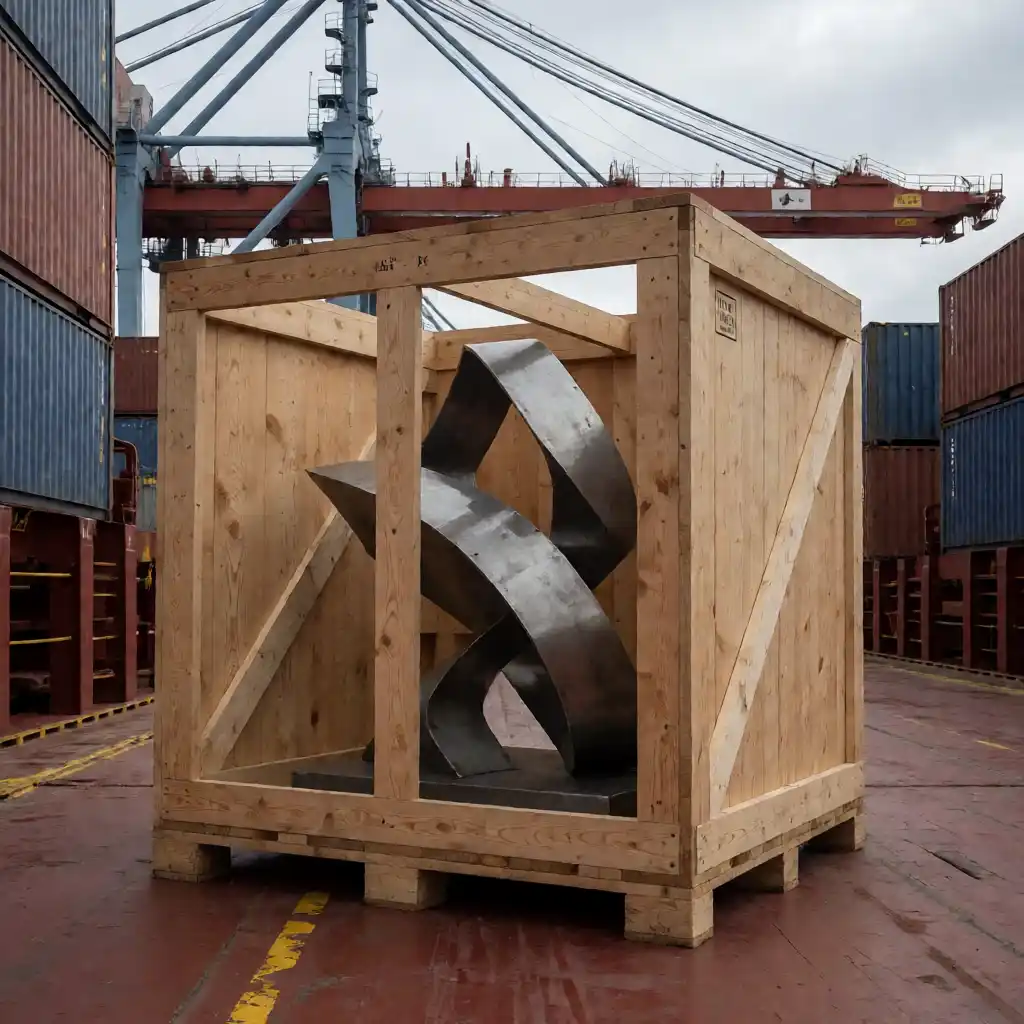
| Freight | 5–12% | Crating, container or flat-rack loading, sea or road freight, port handling, insurance |
| Installation | 10–18% | Crane and rigging, site labour, anchor set-out, alignment, welding on site, touch-up, commissioning |
Notice that design and engineering together are roughly a fifth of the budget, yet they determine whether the remaining four-fifths are spent efficiently. A late change to the form — after fabrication has begun — is the most expensive event in the whole programme.
How to get an accurate quote
A quote is only as firm as the brief behind it. Fabricators pad ranges precisely because they lack these six inputs. Send them all in your first enquiry and you will usually receive a fixed figure instead of a bracket.
- Fixed dimensions. Overall height and width in millimetres, plus an indication of whether these are hard limits (a door, a planning constraint) or approximate.
- Finished grade. 304 or 316 — and if you do not know, tell the fabricator the site location and let them recommend. Coastal means 316.
- Finish type. Brushed, mirror, or an intended visual effect (for example a specific satin level or a coloured PVD coating).
- Site conditions. Coastal, inland, rooftop, plaza, water feature, exposed ridge. Include wind exposure and any salt or industrial atmosphere.
- Installation access. How close can a truck get? Is there a crane on site, or must one be hired? Ground conditions, headroom, and any night-work or permit requirements.
- Timeline. Required delivery and installation window. Compressed programmes attract overtime and expedited freight, which is a legitimate cost line.
Photographs of the site and a marked-up plan resolve most remaining ambiguity. If you have a reference image of the look you want, send it — it shortens the design phase and reduces the risk of a mismatch at approval.
Have a project in mind?
Stainless steel sculpture cost is a range until it is a brief, and this guide is designed to help you get from one to the other quickly. If you can send dimensions, grade, finish, site conditions, access and timeline, we will come back with a fixed figure and a realistic schedule — and, where it helps, a comparison of options at different price points. Request a quote for your stainless steel sculpture and tell us what you are trying to build. We will tell you honestly what it takes to build it well, and what it costs to build it cheaply.
More from the Workshop

Have a Project in Mind?
Send your brief and get a free, honest quote within 24 hours — no obligation.
Request a Quote