
316 vs 304 Stainless Steel for Outdoor Sculpture: A Straightforward Guide
September 16, 2026
Specifying 316 vs 304 stainless steel for outdoor sculpture is one of the first decisions that lands on a landscape architect’s or developer’s desk — and one of the few that is genuinely hard to reverse once the metal is cut. The short version is that 304 is the workhorse alloy and 316 is the marine-grade version, and the difference between them comes down to a single alloying element that decides whether a sculpture still looks sharp in fifteen years or wears a beard of rust-brown tea staining along its welds.
This guide is written for the people who actually have to sign off on the material: landscape architects, developers, hotel engineers and procurement teams. It explains what the two grades are, where each belongs, and how we make the call on real projects.
316 vs 304 stainless steel: what the two grades actually are
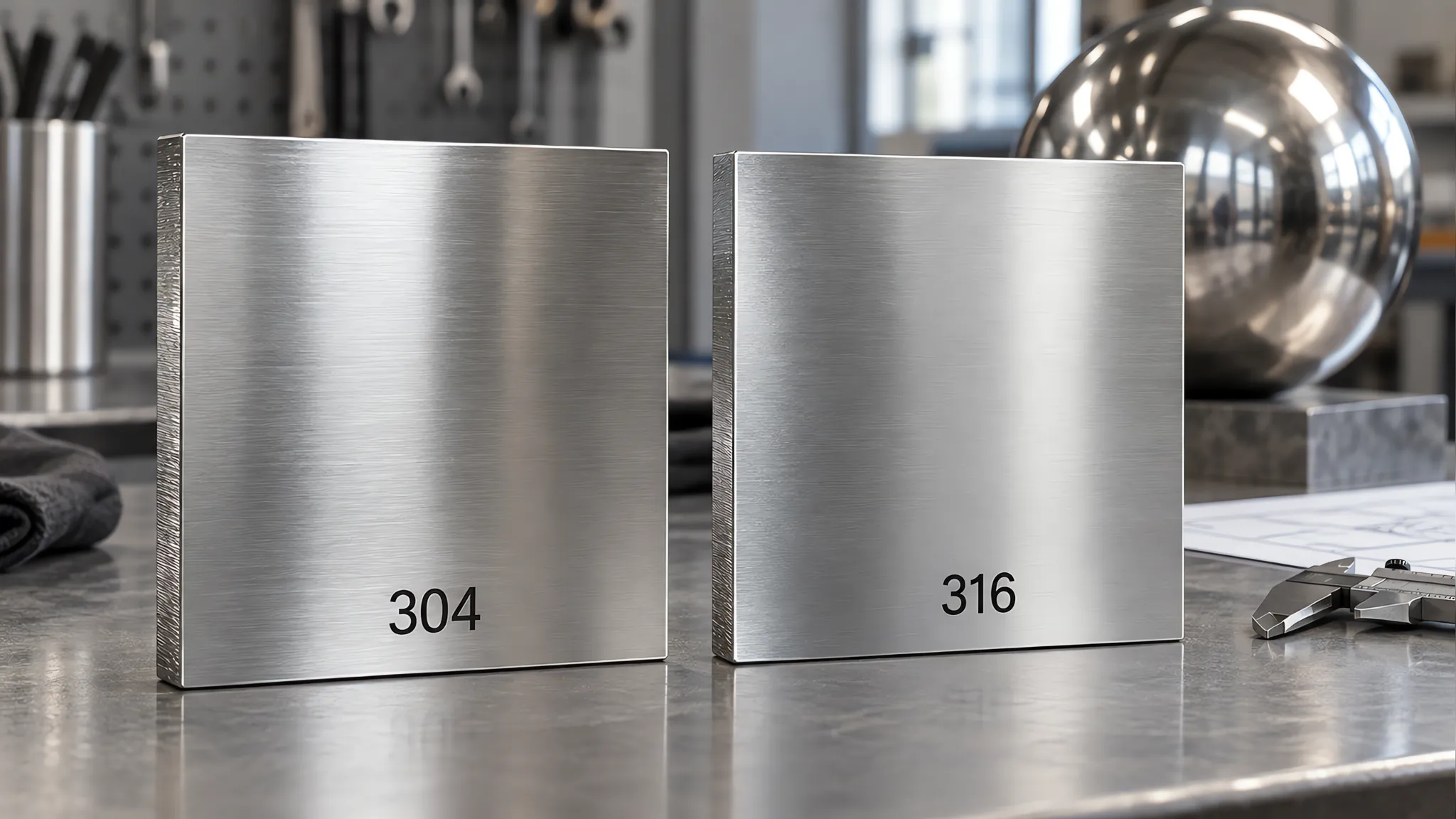
Both grades are austenitic chromium-nickel stainless steels, and both are covered by the same plate and strip standard, ASTM A240. What separates them is chemistry. Grade 304 typically carries 18–20% chromium and 8–10.5% nickel. Grade 316 keeps a similar chromium level, usually 16–18%, but adds 2–3% molybdenum and slightly more nickel, in the 10–14% range. The decorative and architectural members of the family are the low-carbon versions — 304L and 316L — which resist sensitisation at weld seams.
That molybdenum addition is essentially the entire story. Chromium is what makes stainless steel “stainless” in the first place, because it forms a thin, self-repairing chromium-oxide passive film on the surface. Chlorides — the salt in sea air, the chlorine in pool water, the splash from a fountain — attack that film in small local spots, producing the pits that grow into the brown streaks contractors call tea staining. Molybdenum makes the passive film markedly harder to break down in the presence of chlorides.
The industry’s standard way of scoring that resistance is the pitting resistance equivalent number (PREN), calculated as %Cr + 3.3 × %Mo + 16 × %N — a formula published by the Nickel Institute in its corrosion handbooks and used widely by stainless fabricators. On that scale 304 lands around 18, while 316 lands around 24–25. That gap looks small as a number and is very large in a coastal environment: it is the difference between a surface that self-heals and one that pit-corrodes.
When 304 is the right call
It is tempting to specify 316 everywhere “just to be safe”, and it is usually the wrong answer. 316 costs roughly 20–35% more than 304 for the same tonnage, and in a dry, inland, sheltered setting the extra molybdenum is buying protection against a hazard that is not present. On a large-scale sculpture — where material can be the single biggest line item — that premium is real money.
304 is the sensible specification when all of the following are true:
- Dry or sheltered exposure. An atrium, an indoor lobby, a covered entrance canopy, a shopping-mall interior, a rooftop terrace set well back from open water.
- Inland location. The site is a comfortable distance from the coast, so airborne chloride deposition is low. As a working rule, we treat anything beyond about 5 km from open sea as a low-chloride environment unless there is a local source of salt.
- No pool, fountain or irrigation contact. If the piece never sits in splash-zone water and never holds water in a reservoir or channel, chloride attack from standing water is not a factor.
- No regular chemical cleaning. Some facilities clean stainless with chlorinated or acidic products; those turn a mild setting into an aggressive one and push the choice toward 316.
- Cost sensitivity and scale. Where the piece is large and the environment is mild, 304 plus a good passivation regime almost always performs for the intended life of the installation.
None of that means 304 is a compromise option. It is a mainstream architectural grade with decades of documented service indoors and inland. It is simply a grade with a boundary, and the boundary is defined by chlorides.
When 316 is the only sensible choice
There is a category of site where 316 is not a premium upgrade but the minimum defensible specification. Put the piece in any of these conditions without it and you are effectively scheduling a remediation project:
- Coastal and marine sites. Piers, promenades, beachfront plazas, waterfront hotels and marinas. Salt-laden air is a continuous chloride source. The Australian Stainless Steel Development Association (ASSDA) has documented for years that 304 tea-stains quickly in marine and industrial atmospheres while 316 remains serviceable far longer.
- Chlorinated pools and spas. Pool water is warm, chlorinated and constantly evaporating onto adjacent metal — a near-perfect pitting environment. Splash zones on the pool deck are the single most aggressive metal environment in a hotel.
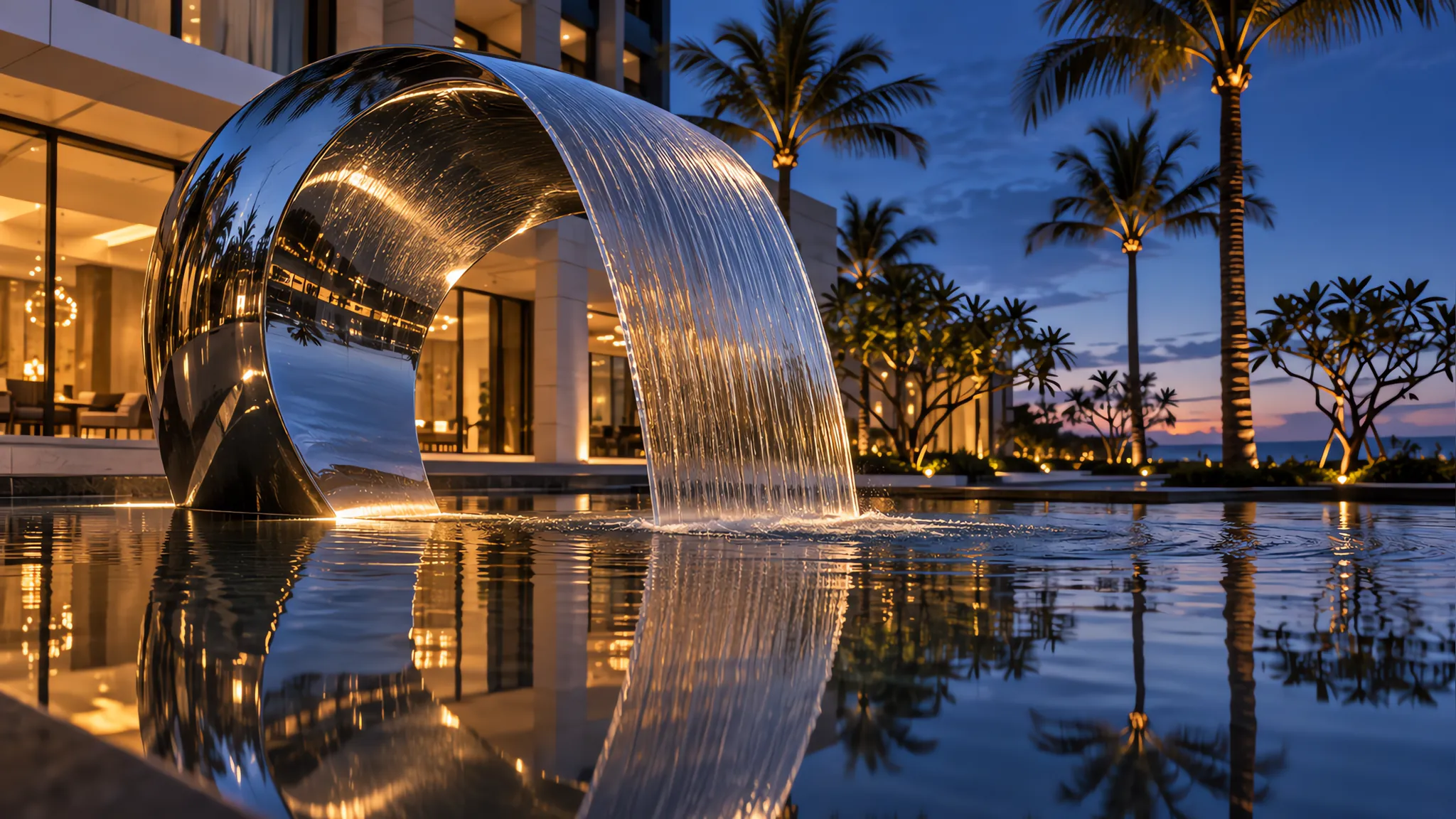
- Water features, fountains and reservoirs. Any sculpture that runs water over itself, sits in a basin, or has concealed wet channels belongs in 316.
- Reflecting pools and brines. Salt-chlorinated pool systems, salt-spray installations and feature water treated with a chlorinator are especially demanding; in warm, high-chloride water we sometimes step past 316 to duplex 2205.
- Highly visible, hard-to-service work. A mirror-polished centrepiece eight metres above a hotel lobby is expensive to inspect, scaffold and refinish. Where maintenance access is poor, buy the margin.
Ordinary 316 is not infinitely immune, and honest specifications say so. In continuously warm, concentrated chloride water — spa temperatures above roughly 40 °C, or a poorly maintained saltwater system — even 316 can pit. Duplex 2205 offers PREN in the high 30s and is the correct next step for those cases.
The real-world signal: salt, chlorine, constant water
Strip the specification theory away and the decision reduces to three environmental signals. If you can answer these, you can specify the grade with confidence.
Salt. How far is the site from open sea, and what is between them? A prevailing onshore wind across 200 m of open beach delivers vastly more chloride than a sheltered inland valley 8 km away. Local experience beats distance — if nearby buildings show rust on their fixings and railings, the atmosphere is aggressive.
Chlorine. Is the piece near a treated pool, spa, or a cleaning regime that uses hypochlorite? Chlorine is the fastest-acting chloride source in a building. The splash zone around a pool ladder is a harsher test than most coastal exposures.
Constant water. Does the surface stay wet? Dry chloride deposits are far less damaging than wet ones. A sculpture that holds a film of water in a concave form, or that is perpetually washed by a fountain, keeps its surface in the corrosive state instead of letting it dry and passivate. Standing water and evaporative edges are where pits start.
Two or three yes answers to those signals, and 316 is the conservative choice. Zero or one, and 304 will very likely serve the full design life.
How we spec it at Y Sculptures
We do not treat the grade as a preference; we treat it as an engineering output. The sequence on a project looks like this:
1. Placement and exposure review. We work from the site plan and the sculpture’s position in it: coastal distance, prevailing wind, shading, whether the piece is under a canopy, and whether any part of it will retain moisture. For water features we ask for the water chemistry — chlorinated, brominated or salt-chlorinated — and the operating temperature.
2. Grade selection. 316L is our default for anything that touches water, sits in a splash zone, or stands within coastal influence. 304 is our default for sheltered, dry, inland interiors and covered exteriors. Where a project is mixed, we specify by component rather than compromise on the whole piece: a 316 water contact surface with 304 structural elements behind it is a legitimate and cost-effective detail.
3. Fabrication discipline. Grade selection only holds if the workshop respects it. That means dedicated tooling and brushes for stainless so carbon-steel contamination cannot seed rust, no grinding wheels that have touched mild steel, and controlled weld practices that suit the L-grade chemistry.
4. Post-fabrication treatment. Every piece is cleaned and passivated after welding, following ASTM A967, so the chromium-oxide film is chemically restored at the weld seams and heat-tinted zones — usually the first places to stain if they are left alone. Mirror-polished work then receives its final polish in a contamination-controlled area.
5. Handover guidance. We hand over a short maintenance note: rinse the surface with fresh water periodically in coastal settings, avoid chlorine-based cleaners on 304, and never use wire wool. Most staining we are called out to inspect was caused by the wrong cleaning product, not the wrong alloy.
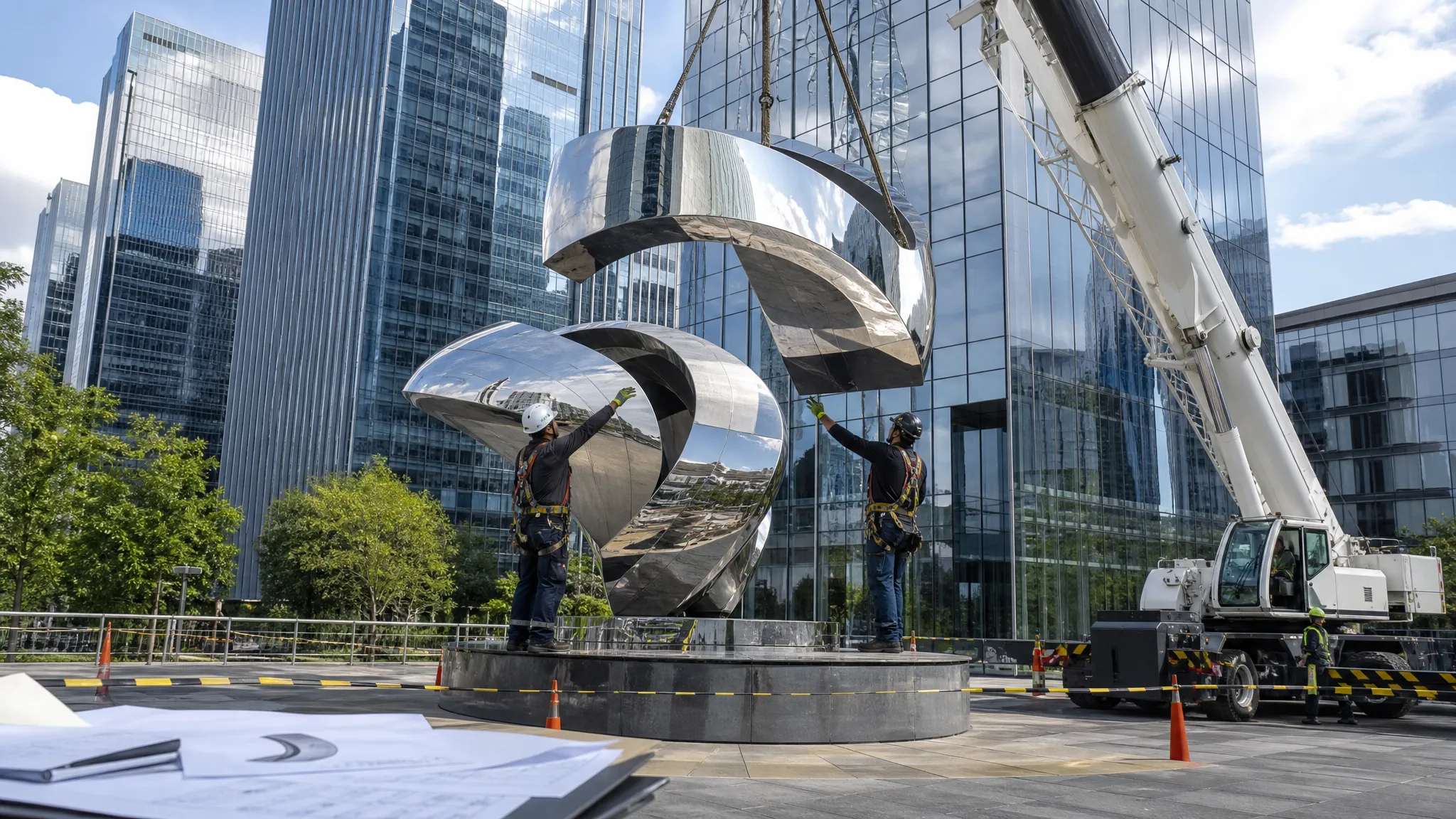
If you want to see how those decisions play out on delivered work, our materials page summarises the grades we fabricate in, and the project portfolio shows the finished result — including the mirror-polished 316 water feature for a boutique hotel courtyard and the 316 stainless sphere garden installation where the grade was driven entirely by the wet, outdoor setting.
316 vs 304 stainless steel: a simple rule of thumb
When you need a fast answer in a design meeting, this table carries most of the decision. It assumes a competent fabrication and passivation process in both cases; poor fabrication will sink either grade.
| Criterion | 304 | 316 |
|---|---|---|
| Typical composition | 18–20% Cr, 8–10.5% Ni | 16–18% Cr, 10–14% Ni, 2–3% Mo |
| PREN (approx.) | ~18 | ~24–25 |
| Indoor / sheltered interior | Correct choice | Unnecessary premium |
| Inland exterior, no water contact | Correct choice | Optional — buy it where access is hard |
| Coastal / marine air | Expect tea staining | Required |
| Chlorinated pool or splash zone | Not suitable | Minimum specification |
| Fountain, basin or water contact | Not suitable | Minimum specification |
| Warm high-chloride water (>40 °C) | Not suitable | Marginal — consider duplex 2205 |
| Typical cost vs 304 | Baseline | +20–35% on material |
| Maintenance | Fresh-water rinse; no chlorine cleaners | Fresh-water rinse |
The takeaway is deliberately unglamorous. 304 is not a cheap substitute and 316 is not a universal upgrade — they are two grades with clearly defined environments, and the environment is knowable at design stage. Get the salt, chlorine and water answers early, decide the grade once, and the sculpture gets to spend its life being looked at instead of being repaired.
Working on a coastal, poolside or water-feature sculpture and want the grade called for you? Send us the site and the brief and we will come back with a specification and a cost comparison for both grades.
More from the Workshop
Have a Project in Mind?
Send your brief and get a free, honest quote within 24 hours — no obligation.
Request a Quote