
Outdoor Stainless Steel Sculpture Maintenance: Keep It Brilliant for Decades
September 18, 2026
Outdoor stainless steel sculpture maintenance is one of those subjects where the marketing and the metallurgy disagree. The sales line is that stainless is “maintenance free”, and the practical reality is that it is low maintenance — not zero. The metal itself is genuinely tough, but the finish you paid for is a thin, reflective skin on top of it, and that skin is what collects the water spots, the fingerprints and the fine scratches you notice from three metres away. The good news is that care for a stainless steel sculpture takes minutes rather than hours, provided you understand which finish you own and what it actually reacts to.
The honest truth: the metal is easy, the finish is not
Grades 304 and 316 will not structurally rust under normal outdoor service. That is not optimism, it is chemistry: both alloys form a chromium-oxide passive layer roughly a few nanometres thick that re-forms instantly when oxygen is present. A sculpture can stand outside for thirty years and still carry its rated load. When a client calls to say their piece “is rusting”, what has almost always happened is that the surface finish has degraded — and a degraded finish looks like failure even though the structure is perfectly sound.
Dullness, water spotting and the occasional shallow pit are finish problems, not metal problems. They appear because the passive layer is only a few nanometres thick and it is continuously being asked to repair itself in the presence of chlorides, standing water and whatever the air carries. Where the layer cannot keep up — under a dried mineral deposit, or inside a scratch that holds moisture — the surface loses its mirror or its satin uniformity, and the reflection breaks up.
This is the opposite of what happens with bronze. A cast bronze sculpture is expected to develop a living patina; the green-brown film is the point, and conservators actively manage it. Stainless has no such tradition. A stainless patina is not a desirable finish — it is a defect, and the whole maintenance regime exists to prevent it. If you are still choosing between the two materials, our comparison of stainless steel versus bronze for sculpture explains where each one earns its place. For everyone who has already installed stainless, the rule is simple: you are not protecting the metal, you are protecting the surface. That is a much smaller, much more achievable job.
What actually damages an outdoor stainless finish
Nearly all visible deterioration on an outdoor stainless sculpture traces back to one of five causes. Learning to recognise them is more useful than any cleaning product, because each has a different remedy.
Hard-water spotting
Rain and tap water both carry dissolved calcium and magnesium. When a droplet dries on a warm, polished surface it leaves the mineral behind as a pale ring. Repeat that a few hundred times over a summer and the rings overlap into a milky haze that no amount of gentle wiping removes. This is the single most common complaint we hear, and it is entirely preventable by drying after wetting.
Fingerprint and grease film
Skin oils and airborne cooking or traffic grease form an invisible film that scatters light. On a mirror finish it reads as a dull patch; on a satin finish it can look like a streak that follows the light. It is harmless to the metal, but it destroys the crisp reflection that justified the polish in the first place.
Airborne chloride
Coastal salt spray, de-icing salt carried on the wind, and pool chlorine all deliver chloride ions to the surface. Chlorides are the one contaminant that can genuinely attack the passive layer, and they are the reason 316 rather than 304 is specified for marine and pool-side work.
Mechanical scratches from cleaning tools
Ironically, most scratches are inflicted by well-meaning maintenance. Abrasive pads, scouring sponges, steel wool and dry paper towels all cut micro-grooves into the finish. Steel wool is worse still: it deposits free iron particles that then rust on the surface, producing brown speckles that look like the sculpture itself is corroding.
Acid rain and industrial fallout
In urban and industrial locations, sulphur and nitrogen compounds in rainfall, plus carbon-rich particulate from traffic and combustion, build a grey film and slowly etch the surface. The effect is cumulative and shows up as a loss of contrast rather than an obvious stain.
Maintenance by finish type
There is no single cleaning interval for stainless steel sculpture maintenance, because the finish dictates the effort. A bead-blasted piece and a mirror-polished piece can sit ten metres apart on the same site and need completely different attention. Identify your finish first, then follow the matching regime. If you are unsure which surface your piece carries, the finish specifications are listed on our sculpture materials reference page.
Mirror-polished — needs regular attention
Mirror polish is the most demanding finish because every imperfection, every water ring and every fingerprint shows against a high-contrast reflection. Inland, plan on a light clean every four to six weeks. At a coastal or pool-side site, every three to four weeks is realistic. The upside is that cleaning is fast: a rinse, a neutral detergent wipe and a dry-down takes under ten minutes on a typical two-metre piece.
Satin and brushed — forgiving, low effort
A satin or brushed finish scatters light rather than reflecting it, which hides water spots and fine handling marks well. Every eight to twelve weeks inland, and every four to six weeks near salt water, is usually enough.
Hairline
Hairline finishes are directional and therefore slightly less forgiving than satin, because an incorrectly directed wipe leaves visible cross-grain streaks. Clean every six to ten weeks, and always work along the grain. Once the habit is set, hairline is nearly as low-effort as satin.
Bead-blasted — the lowest-maintenance option
A bead-blasted surface is matte and micro-textured. It hides everything short of a genuine stain, and a rinse-down twice a year is often the entire programme. The trade-off is that the texture holds contamination a little more tenaciously, so when it does need cleaning, a soft brush is more effective than a cloth alone.
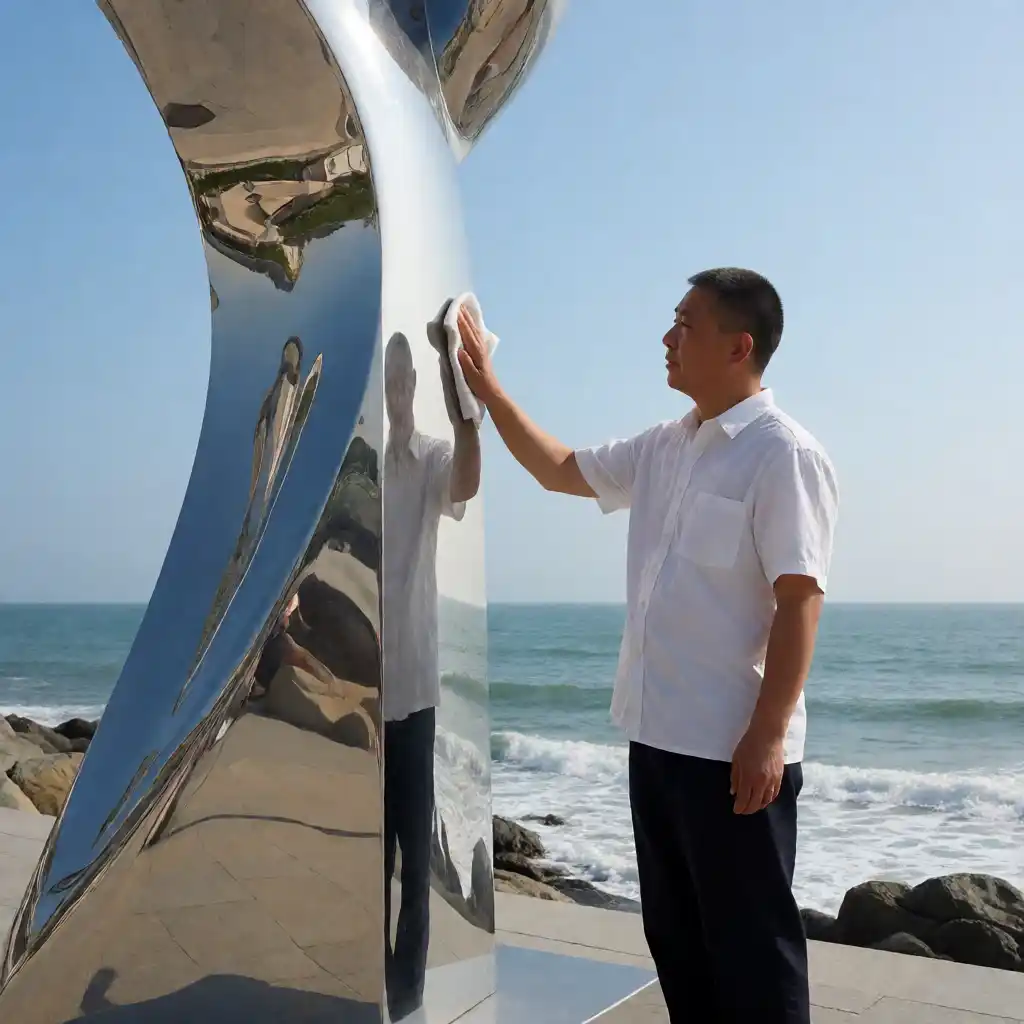
A stainless steel sculpture maintenance frequency schedule
The table below turns the guidance above into practical intervals. Treat it as a starting point and shorten the interval during the first year after installation, when you are still learning how a specific site treats a specific piece.
| Finish | Clean every | Water used | Cloth | Special note |
|---|---|---|---|---|
| Mirror-polished | 3–4 weeks coastal; 4–6 weeks inland | Soft or filtered water | Clean microfibre, one per pass | Dry immediately; never let it air-dry |
| Satin brushed | 4–6 weeks coastal; 8–12 weeks inland | Warm tap water is fine | Soft microfibre | Always wipe along the grain direction |
| Hairline | 6–10 weeks | Warm tap water | Soft microfibre, single direction | Cross-grain wiping is the main risk |
| Bead-blasted | Twice a year | Warm tap water | Soft brush plus microfibre | Brush gently; rinse thoroughly afterwards |
A simpler rule sits alongside the table: any time the sculpture has been rained on, misted with salt spray or splashed with chlorinated water, give it a fresh-water rinse and a dry-down within a day or two.
The correct stainless steel sculpture maintenance and cleaning routine
The routine is short, and the order matters more than the products. Work top to bottom so that dirty water never runs onto a section you have already cleaned.
- Rinse first, with soft water. Flood the surface to lift loose dust and grit. Rinsing before wiping is what prevents scratches — grit trapped under a cloth is the usual cause of “mystery” scratches.
- Wash with warm water and a neutral pH detergent. A few drops of mild dish soap in a bucket of warm water is ideal. Neutral pH means the detergent will not attack the passive layer.
- Wipe along the grain. On brushed and hairline finishes, move the cloth in the direction of the visible lines. On mirror finishes, work in straight overlapping passes rather than circles.
- Rinse thoroughly. Detergent residue left on the surface attracts dust and dries to a film. Rinse until the water sheets evenly with no soap streaks.
- Dry with a clean microfibre cloth. This is the step people skip, and it is the step that matters most. Drying is what prevents hard-water spotting.
- Retire cloths that have touched the ground or grit. A contaminated cloth will scratch every surface it touches afterwards.
For visible salt or mineral residue, a 1% white vinegar solution works as a one-off rinse — follow it immediately with fresh water and a dry-down. Vinegar is acidic: treat it as a remedy, not a routine cleaner.
What to never use on stainless
Almost every stainless “horror story” we are asked to repair starts with a cleaning product that should never have been near the surface. The list is short, and it is worth memorising.
- Abrasive pads and steel wool. They scratch the finish and embed free iron particles, which then rust and leave brown specks that look like corrosion of the sculpture itself.
- Chlorine bleach. Sodium hypochlorite is aggressive towards the passive layer and is a direct cause of pitting. Never leave a bleach solution on stainless, even briefly.
- Harsh acids and strong alkalis. Mortar and grout removers, limescale descalers and oven-type cleaners will etch the surface within minutes.
- Wire brushes and metal scrapers. These cause deep mechanical damage and can transfer iron contamination in a single pass.
- Wax-based “metal polishes”. The wax fills the surface and gives a short-lived shine, then yellows and traps dirt. It creates far more work later than it saves now.
- Pressure washing at close range. High-pressure jetting can erode a bead-blasted texture and drive water into seams and fixings. If you must pressure wash, keep the nozzle well back and use a wide fan.
Coastal and pool-side sites need more
Chloride is the variable that changes everything. Inland, a stainless sculpture may go its whole life without ever seeing a chloride concentration high enough to matter. Within a few hundred metres of the sea, or beside a chlorinated pool, the surface is dosed regularly with chloride ions that interfere with the passive layer’s ability to repair itself. Add repeated wetting and drying — the classic pattern on a promenade or a pool deck — and you have the conditions under which pitting actually starts.
That is why specifiers move up to grade 316 for coastal work: the molybdenum in 316 makes the passive layer markedly more resistant to chloride attack. The background is covered in detail in our guide to 316 versus 304 stainless steel for sculpture. A marine installation such as our coastal 316 stainless sculpture is built around that grade, and the specification only works if the maintenance regime keeps pace with the environment.
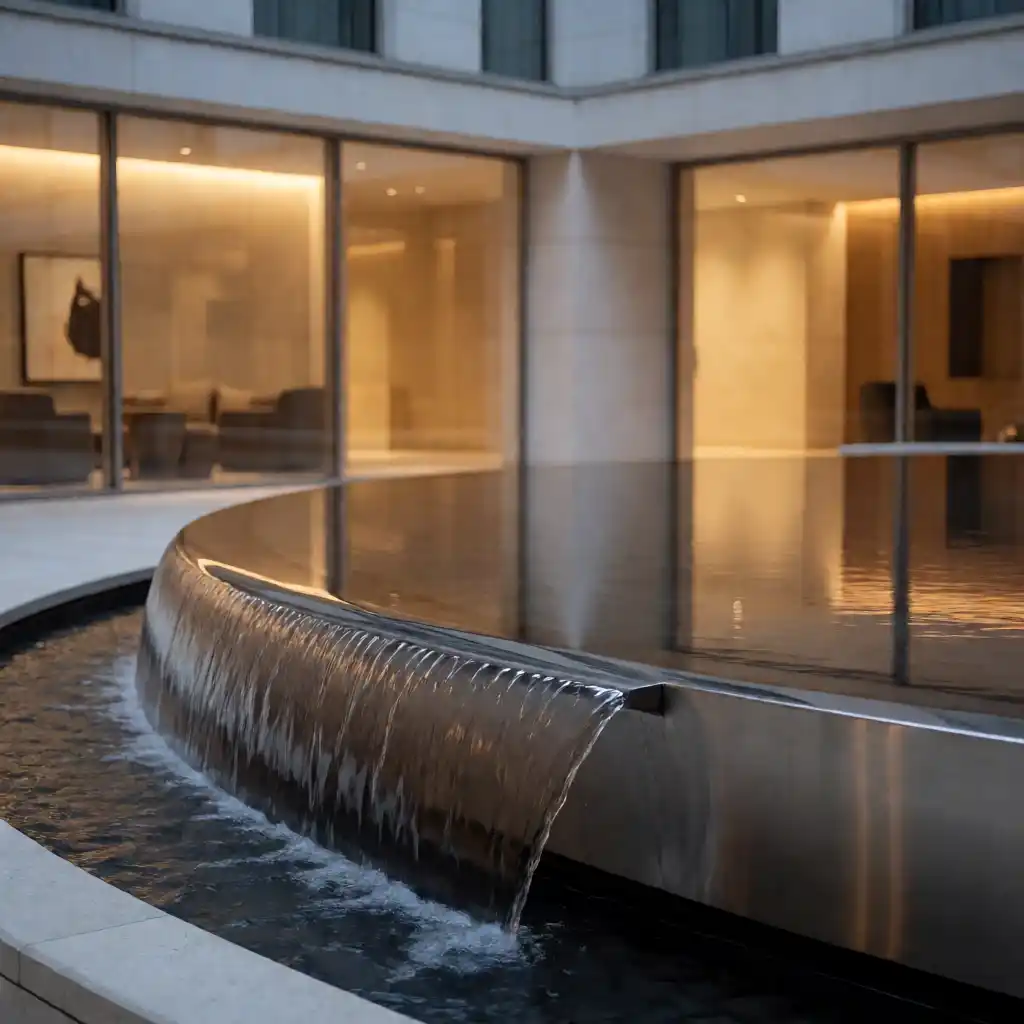
If your piece sits in permanent wet contact, the stakes rise again. A hotel water-wall installation is never dry, so deposits never get the chance to wash away; those fixtures need scheduled descaling with a neutral product rather than occasional cleaning.
For every chloride-exposed site, the single highest-value maintenance action is also the cheapest: rinse the sculpture with fresh water after salt spray or chlorinated splash, and dry it. A thirty-second rinse after a storm removes the chloride that would otherwise sit on the surface for days. Nothing else you can do delivers the same return.
When dullness becomes a problem
Not all dullness is equal. The three categories below need very different responses, and the way to tell them apart is to clean the area properly first — a surprising number of “problems” are simply films that never got removed correctly.
Surface staining that rinses out
If a mark disappears with warm water, neutral detergent and a microfibre dry-down, it was a deposit: mineral spotting, grease film, dust or salt residue. This is normal wear on the maintenance cycle. No repair, no cost, no specialist involvement.
Etching that needs a repolish
If the mark survives cleaning and you can see it in a raking light as a change in surface texture rather than something sitting on top of the surface, the finish has been etched or micro-scratched. This is a cosmetic problem, not a structural one. The remedy is a localised repolish by a fabricator, which restores the original finish in the affected area. Because repolishing is a skilled operation, it carries a real cost — typically a modest fraction of the original fabrication price, and it is worth pricing alongside the alternatives. Our stainless steel sculpture cost guide breaks the numbers down so you can compare repolishing against replacement.
Pitting that requires local repair or replacement
Pitting is different. Look for small dark dots or clusters that have depth, often with a rust-coloured bloom, and focus on places where water sits: horizontal ledges, the base plinth, low recesses and fixing points. Pitting is the one condition that does reach the metal. Light, localised pitting can be ground out and re-polished by a fabricator; extensive pitting across a large panel may make replacement of that section the more economical choice. Any pitting on a piece installed in the last two years is worth reporting to the original supplier, because it usually points to a grade or fabrication issue rather than maintenance.
| Symptom | What it means | Action |
|---|---|---|
| Mark vanishes when cleaned | Deposit: mineral, grease or salt film | Keep the routine; shorten the interval |
| Visible in raking light, flat, no depth | Etching or micro-scratch in the finish | Localised repolish by a fabricator |
| Dark dots with depth and a rust bloom | Pitting into the metal | Grind out and repolish; replace panel if extensive |
Have a project in mind?
Stainless steel sculpture maintenance is far less daunting once you match the routine to the finish and the site. If you are specifying a new piece — or replacing one where the finish has been lost — we can advise on the right grade and the right surface for your environment before fabrication begins. Tell us the location, the exposure and the look you want, and we will recommend a finish that stays brilliant with the care you are realistically able to give it. Request a quote for your stainless steel sculpture project and we will come back with a specification, a finish recommendation and a maintenance schedule written for your site.
More from the Workshop
Have a Project in Mind?
Send your brief and get a free, honest quote within 24 hours — no obligation.
Request a Quote