
Stainless Water Feature vs Fountain: Which Is Right for Your Space?
September 16, 2026
Stainless Steel Water Feature vs Fountain: The Core Difference
The question architects and hotel developers ask us most often is not which finish to specify, but which object to build: the stainless steel water feature vs fountain decision. Both move water through a closed recirculating loop with a pump, both can be fabricated in 304 or 316 stainless, and both look spectacular in a render. The difference only becomes visible once you know where the water actually goes, how much wind the site gets, and who has to clean it in year five. This article walks through the four things that genuinely decide it — appearance, hydraulics, maintenance and running cost — and finishes with a decision table you can take straight into a design meeting.
A water feature treats water as a surface. The water is a thin film or sheet that runs over a sculptural form and disappears into a concealed trough, or it is a still reflecting plane that mirrors the sculpture and the sky. The water never leaves the container, so the piece reads as architecture first and moving water second. A fountain treats water as a projectile. Jets throw water into the air, it breaks into droplets, aerates, catches the light and falls back into an open basin. The movement is the display. Everything else — pump duty, basin depth, cleaning routine, wind exposure — flows from that single structural difference.
Look and Feel: the Reflective Object or the Playful Jet
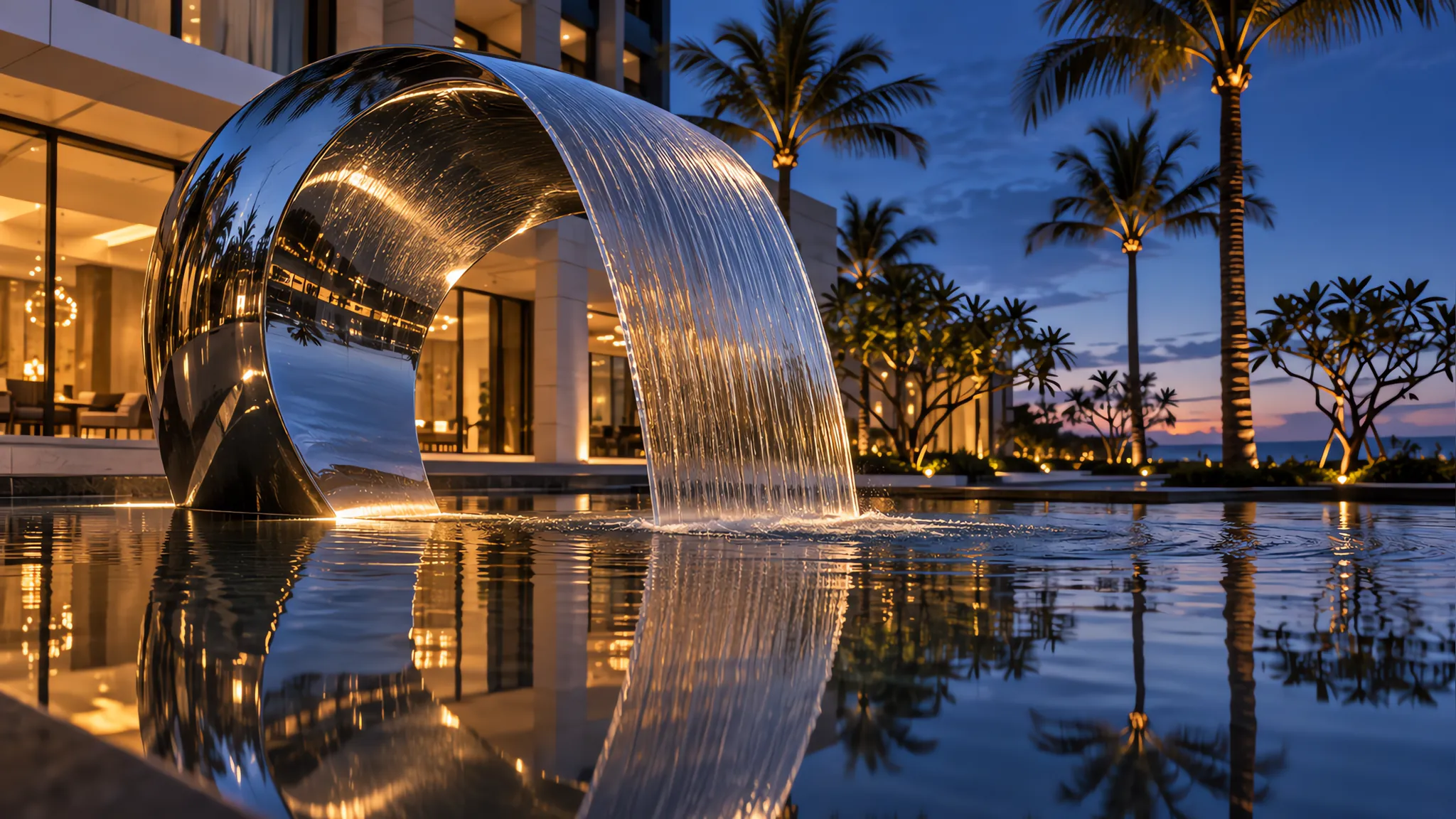
A sculptural water feature is a quiet, high-value gesture. Mirror-polished stainless with a moving water film animates the reflections around it: the sky changes through the day, the building façade slides across the curve, interior lights come up at dusk and start to glow through the film. In a hotel arrival court or a lobby forecourt this reads as luxury and calm, and it photographs well from almost any angle. Critically, the sculpture still reads as a piece of design when the pump is switched off — a point that matters more than most clients expect.
A fountain is an active, social gesture: movement, splash, sound and energy. Broadband jet noise is genuinely useful in a noisy urban plaza because it masks traffic, and the open basin is inherently playful — exactly what retail, leisure and family settings want. The trade-off is that a fountain depends on its pump for its identity: when the pump is down, what remains is an empty basin, a ring of visible nozzles and a maintenance hatch.
Engineering Reality: Pumps, Overflow Edges, Wind Spray and Water Chemistry
Pump duty. A water feature is low-head, low-flow work. The pump is sized to deliver a specific flow per metre of weir so the film stays continuous, and to lift water from a shallow catch trough a few hundred millimetres below. A fountain is the opposite: it needs head and pressure to throw water to a designed height, plus enough nozzles to shape the display. A three-metre jet cluster can easily need 2.2–4 kW, where a comparable sheeting water feature usually runs in the 0.75–1.5 kW band. That gap shows up in the plant-room size and the monthly bill.
Overflow edges and basin volume. With a water feature the weir is the whole game. The overflow edge has to be machined and levelled so the film is even across its full length, typically within about a millimetre; an uneven edge produces a dry patch or a heavy lobe that reads as a fault. Because the water surface is contained and recessed, the trough can be slim, and the critical structural work is a base that will not settle. A fountain needs the opposite: a deep basin sized to absorb the surge draw-down when the jets start — usually two to three times the visual water volume — plus a pump chamber a technician can reach without draining the pool.
Wind spray. This is the practical differentiator on exposed sites, and the one most often designed out too late. Jets throw water into the air, and wind takes it sideways: wet walkways and a slip risk, mineral staining on paving and glazing, and accelerated corrosion on nearby aluminium handrails and signage. A contained water feature keeps its water inside a recessed trough, so drift is near zero and the piece can sit directly beside a walkway, a restaurant terrace or a pool deck. If you want jets in a breezy location, budget for a wind study, a recessed trough, slot drainage and possibly a raised deflecting lip.
Water chemistry and evaporation. Where chlorine or salt is in play — beside a pool or on a coastal site — specify 316 marine grade rather than 304, and seal the surfaces. An open fountain basin loses far more water: evaporation plus airborne drift means constant top-up and chemical dosing in a hot or windy climate. A water feature with a covered trough exposes very little surface and needs very little make-up water. Both systems need filtration; the fountain additionally needs skimming and nozzle descaling.
Maintenance and Running Cost
Running cost is pump energy plus make-up water, chemicals and the labour to keep the water clean. Because the fountain pump works against a higher head and the basin loses more water, a fountain normally costs more per month than a comparable water feature on the same site.
Maintenance focus differs too. A water feature asks you to keep the weir edge clear and free of scale so the film stays even, and to rinse the polished surface. A fountain asks you to de-scale nozzles, skim the basin, manage algae and hold the water chemistry in range, because an aerated open basin is a much friendlier environment for biological growth.
There is also a strategic cost that never appears in the maintenance schedule: downtime visibility. If a fountain pump fails, the site loses its focal point and the empty basin becomes the story. If a water feature pump fails, the sculpture still stands. For a brand judged on the first ten seconds of arrival, that resilience is often the deciding argument.
Stainless Steel Water Feature vs Fountain: The Decision Table
| Criterion | Water feature | Fountain |
|---|---|---|
| Primary visual | Mirror-polished sculpture with a moving film of water | Jets of water thrown into the air and shaped |
| Water behaviour | Thin sheet over a form, or a still reflecting plane — contained | Aerated droplets and vertical displays — open basin |
| Spray and wind risk | Minimal; water stays in a recessed trough | High on exposed sites; drift wets paving and nearby finishes |
| Placement freedom | Can sit beside walkways, terraces and dining areas | Needs open fetch, wind analysis and often guarding |
| Evaporation and make-up water | Low — small exposed surface | Higher — large exposed surface plus airborne losses |
| Pump duty | Low head, low flow, sized to the weir perimeter | Higher head and flow; larger pump and supply |
| Basin and structure | Slim catch trough; the critical work is a stable, level base | Deep basin to absorb surge draw-down, plus plant chamber |
| Sound | Soft, continuous murmur | Broadband and active; useful for masking traffic noise |
| Reads when the pump is off | Yes — still a sculpture | No — an empty basin and visible nozzles |
| Cleaning focus | Weir-edge scale and even film | Nozzle descaling, basin debris, algae control |
| Water treatment | Closed loop, easy to keep clean | Open basin, skimming and dosing required |
| Typical running cost | Lower | Higher |
| Best suited to | Hotel arrivals, courtyards, lobbies, terraces, poolside | Plazas, retail, parks, leisure and family settings |
When to Choose Each: Hotel, Plaza, Pool and Coastal Sites
Hotel arrivals and courtyards. A water feature. Guests walk past it and photograph it, and a wet walkway is unacceptable in a hospitality setting. See how a mirrored piece works in a confined court in our boutique hotel courtyard water feature project, where the film runs continuously and the overflow edge hides inside the planting.
Commercial plazas, retail and parks. A fountain usually wins, because the brief is activity, gathering and noise masking rather than quiet luxury. Our resort pool fountain project shows the configuration to expect: bigger pump, deeper basin, a service chamber and a wind analysis before the nozzles are fixed.
Pools and terraces. Specify a contained water feature in 316, because chlorine and salt are both present. If a fountain is essential, keep its basin hydraulically separate from the swimming pool and site it where drift will not reach the deck.
Coastal and marine sites. Both are buildable in 316 marine grade, but salt air plus wind makes a fountain the riskier spec: drift carries chlorides onto surrounding finishes and accelerates corrosion on adjacent metalwork. A contained feature with sealed surfaces is normally the safer long-term choice.
Mixed-use or uncertain briefs. A hybrid works well: a sculptural stainless form with a small, contained jet cluster at its base. The sculpture reads with the pump off, the movement reads when it is on, and the water never leaves the trough. Several pieces in our project portfolio are engineered this way.
If the site is a genuine water-feature brief — hotel, resort, terrace or poolside — start with our water feature application page for the material and engineering logic we apply by default. Then send us the plan, the prevailing wind direction and the power available, and we will come back with pump duty, basin volume and a rough running cost for each option, free and within 24 hours. That comparison, done before the design is frozen, is the cheapest decision in the whole project.
More from the Workshop
Have a Project in Mind?
Send your brief and get a free, honest quote within 24 hours — no obligation.
Request a Quote