
Commercial Water Feature Design, Engineering and Contractor Selection: A Guide for Developers
September 23, 2026
Every commercial water feature is sold as a rendering and delivered as a small industrial plant. The render shows water sliding over a polished rim; behind it sit a pump station, a filtration loop, a dosing rig and a service contract that must survive fifteen years of daily use. That gap decides whether the feature looks sharp in year ten or is switched off by year three.
This guide is for the people who carry that risk: developers signing off capital budgets, facility managers who inherit the plant room, and design teams who must fix the feature type and flow rate before the concrete is poured. It covers what makes a water feature commercial, the decisions that cannot be reversed, and what to ask any commercial water feature contractor. Most commercial water feature failures are not sculpture failures.
What Makes a Water Feature “Commercial”?
A domestic feature runs when somebody remembers to switch it on. A commercial water feature is building services infrastructure that happens to be beautiful. Four characteristics separate the two.
- Duty cycle. Typically 10–14 hours a day, 365 days a year — 55,000–75,000 hours over a fifteen-year life. Domestic pumps are not built for that.
- Public safety. The public stands beside it and walks through it, so electrical protection, slip resistance and guarding come into scope.
- Treatment compliance. Recirculating water in a public place is a regulated system whose records join the asset register.
- Service access. Somebody must clean a strainer and read a chemical test weekly for fifteen years. With no safe route to the plant, that never happens.
Design Decisions That Must Be Settled Before the Structure Is Poured
Feature type, flow rate and head determine the basin size, plant room depth, every pipe diameter and the electrical supply. Once the structure is cast, changing them means demolition. Settle them first and the commercial water feature design becomes buildable; leave them open and it becomes a permanent argument.
Feature Type: From Reflective Pan to Jet Array
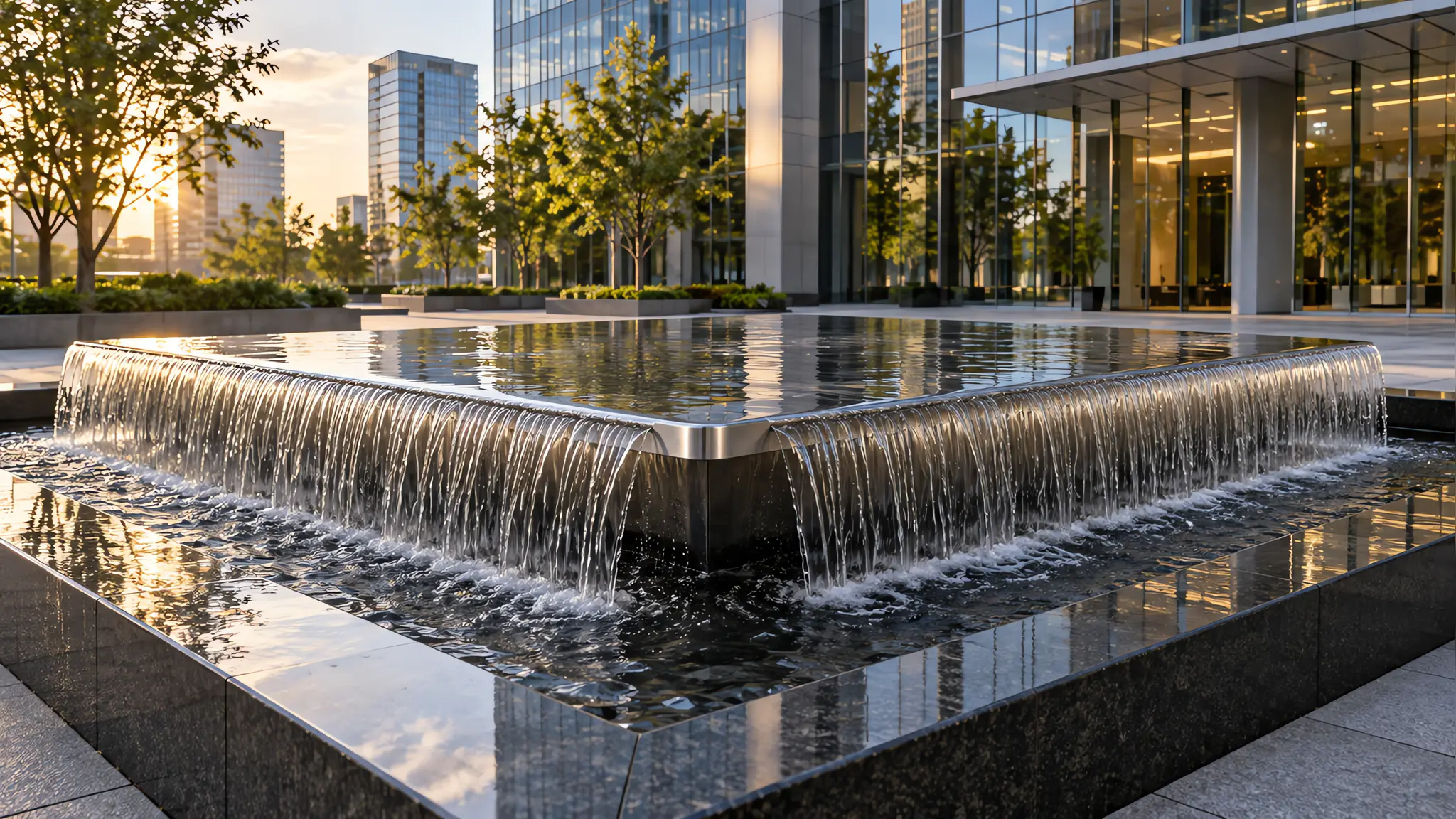
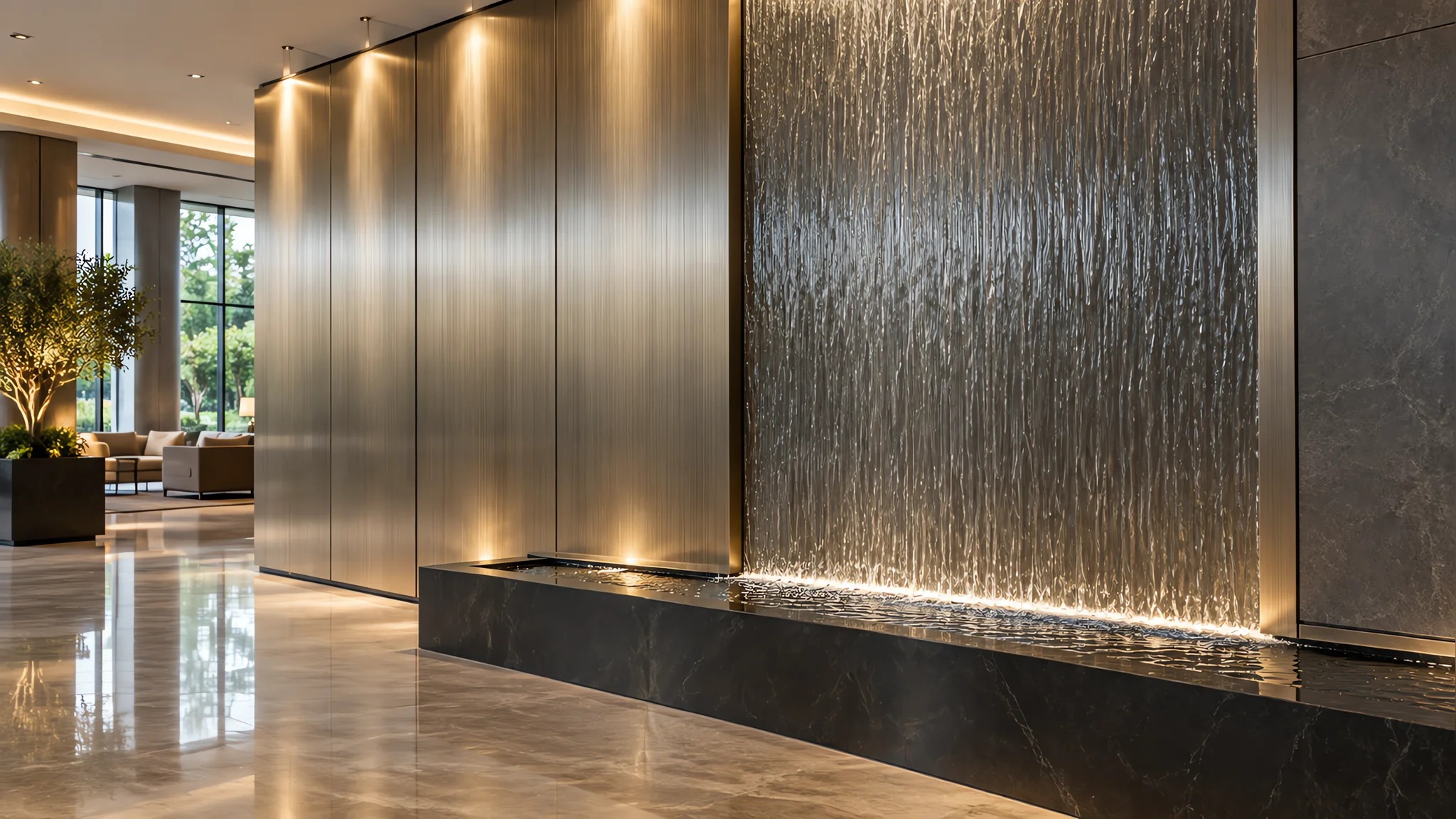
Six types dominate commercial work. A still reflective pan holds water within 3–5 mm of the rim and draws 0.5–1.5 kW, but any ripple destroys the mirror. A rim overflow projects a continuous film over a machined edge, making the edge the entire product — ±0.5 mm straightness is normal. A water wall needs 60–120 litres per minute per metre of width. A rill runs laminar and near silent. A cascade is a deliberate noise generator. A jet array is the highest-energy option, with 2–8 m of head and real sensitivity to wind.
If you are still choosing between a still architectural feature and a jet-driven one, our comparison of a stainless water feature vs fountain sets out where each wins, and our water feature applications page shows how it reads on site.
Flow Rate and Head Come First
Flow rate sets pipe sizes and turnover time; head sets pump pressure. Never let a contractor size the pump on as-new figures: add 15–20 per cent for a loaded filter, 10 per cent for a partly blocked strainer, and 20–30 per cent of the tallest jet height. A pump sized at exactly the theoretical duty point is off its curve within a year.
The Systems Behind the Visible Water
The visible water is roughly ten per cent of the project. Our article on stainless steel water feature engineering goes deeper into pump curves and overflow edges; below is what a facility manager must recognise.
Pumps: Duty, Standby and N+1
A single pump is a single point of failure. For a feature fronting a hotel entrance or retail plaza, specify duty plus standby with automatic changeover. Typical commercial pumps run 1.5–7.5 kW, and a variable-speed drive pays for itself by running a 4 kW pump at 70 per cent speed overnight.
Filtration and Treatment
Mechanical filtration to 20–50 microns plus a residual disinfectant is the baseline. UV is a useful secondary barrier but no substitute for a residual — it treats water passing the lamp and nothing in the basin overnight. Specify automatic dosing with ORP and pH control, hold free chlorine at 0.5–1.0 mg/l and pH at 7.2–7.8, and turn over a display pool in one to two hours.
Level Control, Drainage and Freeze Protection
Automatic level control with a mechanical float as fail-safe, a metered make-up supply, and an overflow discharging to a legal point — chlorinated water often cannot go straight to a storm drain. Evaporation from an exposed pan runs 3–8 mm a day in summer; meter the make-up line and you will spot a leak early. Below zero, run continuously, trace heat, or drain fully; a drained system with one undrained low point will crack there.
The Plant Room and Service Access: The Most Commonly Botched Items
This section belongs in the project brief. Plant rooms get squeezed into leftover space with no drain, no light and no clearance, then handed to a team who cannot service anything in them. Insist on 600–800 mm clear working space around every item needing attention, a floor drain and hose point, a bunded chemical store, ventilation, and a lockable power and light supply. Label every pipe run, laminate a schematic on the wall, and make certain the sump is genuinely the lowest point.
Water Quality and Public Health
Aerosol-producing features — jets, sprays, misting — raise the legionella and biofilm question. A still pan is not an aerosol source; a jet array beside a building air intake is, and then an aerosol risk assessment is a genuine requirement. Stagnation is the enemy, so keep water moving and never leave a basin full and untreated through a shut-down. Test free chlorine and pH daily, microbiologically weekly in the first months, and keep a documented schedule of control.
Splash, Wind Drift and Slip Liability
Spray can be predicted before it soaks a forecourt, and modelling wind is cheaper than re-pouring paving. Drift runs at roughly 0.3–0.6 times jet height in a 3–5 m/s wind, and up to one times jet height on a gusty coastal site, so a 4 m jet on an exposed forecourt wets two to four metres of paving downwind. Fix it at design stage: a wind sensor that shuts down above roughly 8 m/s, the array oriented across the prevailing wind, and R11 or R12 paving in the wet zone.
Noise: Design Asset or Nuisance
Moving water masks traffic. A 1–2 m fall at 100–200 litres per minute adds useful broadband masking in front of an urban hotel. The same feature under a bedroom window is a complaint generator, and night-time limits are stricter. Cascades and jet arrays make noise; still pans and rills are near silent, so within 30 m of housing keep it quiet and commission an acoustic assessment.
Materials: Why Chlorinated and Coastal Water Demand 316
Chlorinated recirculating water and salt air both release free chloride, and free chloride drives pitting corrosion in 304 stainless. Specify 316 or 316L for the basin, visible steel, pump internals and every fastener; the 2–3 per cent molybdenum is what buys chloride resistance. Grade choice is only half the answer: full-penetration welds, 316L filler, no carbon-steel tooling on site, and pickling and passivation of every weld. Our guide to 316 vs 304 stainless steel for outdoor sculpture covers the grades.
Commissioning and Handover
Commissioning is where promises become measurable. Demand a hydraulic test at design flow, measured flow and head at the pump, water test results taken before handover, as-built drawings showing buried pipe routes and valve positions, a labelled plant room, and training for the team who will run it. The O&M manual matters most, and a proper one is project-specific: pump curves, filter intervals, dosing setpoints, a spare parts list with numbers, and a maintenance schedule.
The Commercial Water Feature Maintenance Contract
Decide who services the feature before handover, not after the first breakdown. A realistic commercial water feature maintenance schedule is weekly strainer cleaning and water testing, monthly filter backwash and dosing calibration, quarterly UV lamp replacement, and an annual deep clean and corrosion inspection. A mid-size commercial feature typically costs $6,000–$25,000 a year to service — broadly 3–8 per cent of capital. Whoever holds the contract needs the O&M manual, the parts list and a documented testing regime; it is closer to the maintenance regime for outdoor stainless steel sculpture than to fabrication.
Typical Capital and Operating Cost Ranges
Capital cost tracks hydraulic duty more than visual size. Including plant room and controls, a small reflective pan runs roughly $25,000–$60,000; a rim overflow $40,000–$90,000; a water wall $60,000–$150,000; a rill or cascade $50,000–$120,000; and a jet array $150,000–$500,000 or more, driven by nozzle count and head. Operating cost is the forgotten number — energy, make-up water, chemicals and the service contract commonly total one to two times capital across fifteen years, so budget for it at approval stage.
Decision Table: Site Type, Feature Type and Material
Use this as a starting point, then verify the hydraulics on site; our water feature portfolio shows how these combinations perform in practice.
| Site type | Feature type | Material | Watch out for |
|---|---|---|---|
| Hotel forecourt or entrance | Rim overflow, still pan | 316 stainless, mirror or satin | Wind drift onto paving; night noise; duty/standby pump |
| Mall or atrium interior | Water wall, rill | 316 stainless, brushed | Humidity and slip risk; plant access from a service corridor |
| Commercial plaza or square | Jet array, cascade | 316 stainless, bead-blasted | Wind sensor, aerosol assessment, vandalism, freeze protection |
| Park or landscape scheme | Cascade, rill, still pan | 316 stainless; 304 acceptable inland | Leaf ingress, seasonal shut-down, drainage to a legal point |
| Pool terrace | Rim overflow, rill | 316 stainless | Chlorinated splash zone, bonding and earthing, slip rating |
| Coastal or marine setting | Any type, simplified geometry | 316L only, passivated welds | Salt-laden air, more frequent cleaning |
| Residential-adjacent site | Still pan, rill, low cascade | 316 stainless, satin | Noise limits, night operation, acoustic assessment |
For high-footfall public squares specifically, our commercial plaza applications page covers the placement and access questions that come with the setting.
Most Failures Are Maintenance and Plant-Room Failures
It is worth repeating. When a commercial water feature underperforms, the sculpture is almost never the cause. What fails is the strainer nobody cleaned, the make-up water nobody metered, the drain the plant room never had, and the testing log never started. Those are design and contract decisions, made long before anyone looks at a finish sample.
Have a project in mind?
We fabricate large stainless steel sculptures and commercial water features for hotels, plazas, parks and coastal schemes, working with architects, landscape designers and facility teams from concept to commissioning. Tell us the site, the flow rate you need and the plant room you have, and send us the project details for a buildable specification — including hydraulic duty, material grade and the maintenance schedule you should budget for.
More from the Workshop

Have a Project in Mind?
Send your brief and get a free, honest quote within 24 hours — no obligation.
Request a Quote