
Stadium Gateway Landmark Sculpture
Stadium authority · Melbourne, Australia · 316 Stainless
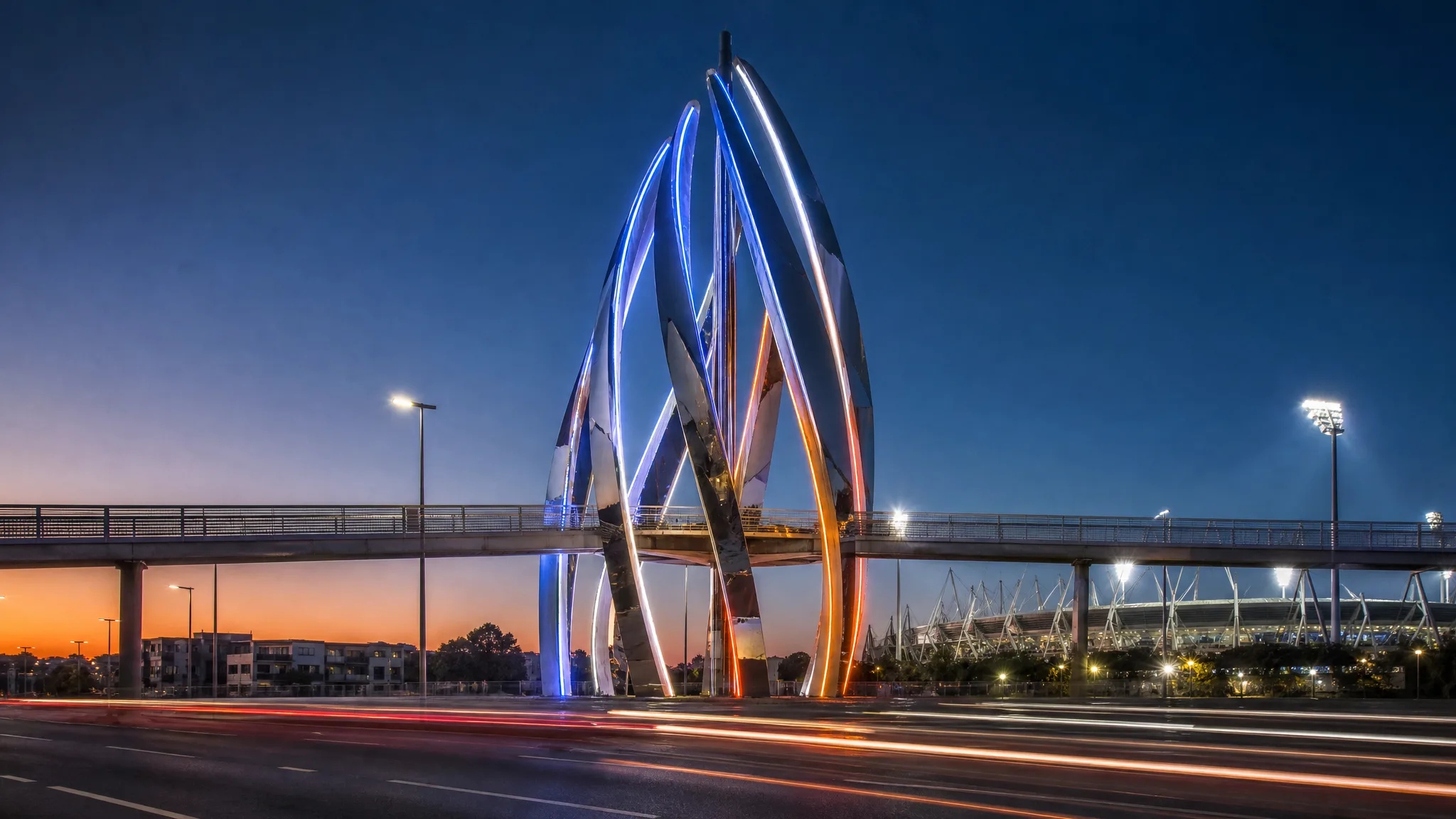
A soaring gateway sculpture at the main pedestrian approach to a 70,000-seat stadium, marking the transition from the city streets into the event precinct. The piece must read at 80 km/h on the arterial road, at walking pace on the pedestrian bridge, and under broadcast floodlights for televised events.
The brief
An 18 m tall landmark that reads as a single gesture from the arterial road, fragments into a cluster of fins on the pedestrian bridge, and carries dynamic LED lighting for event-night colour changes. Wind region D, terrain category 2, importance level 3 — the structure must survive a 1-in-1000-year gust without permanent deformation.
Design approach
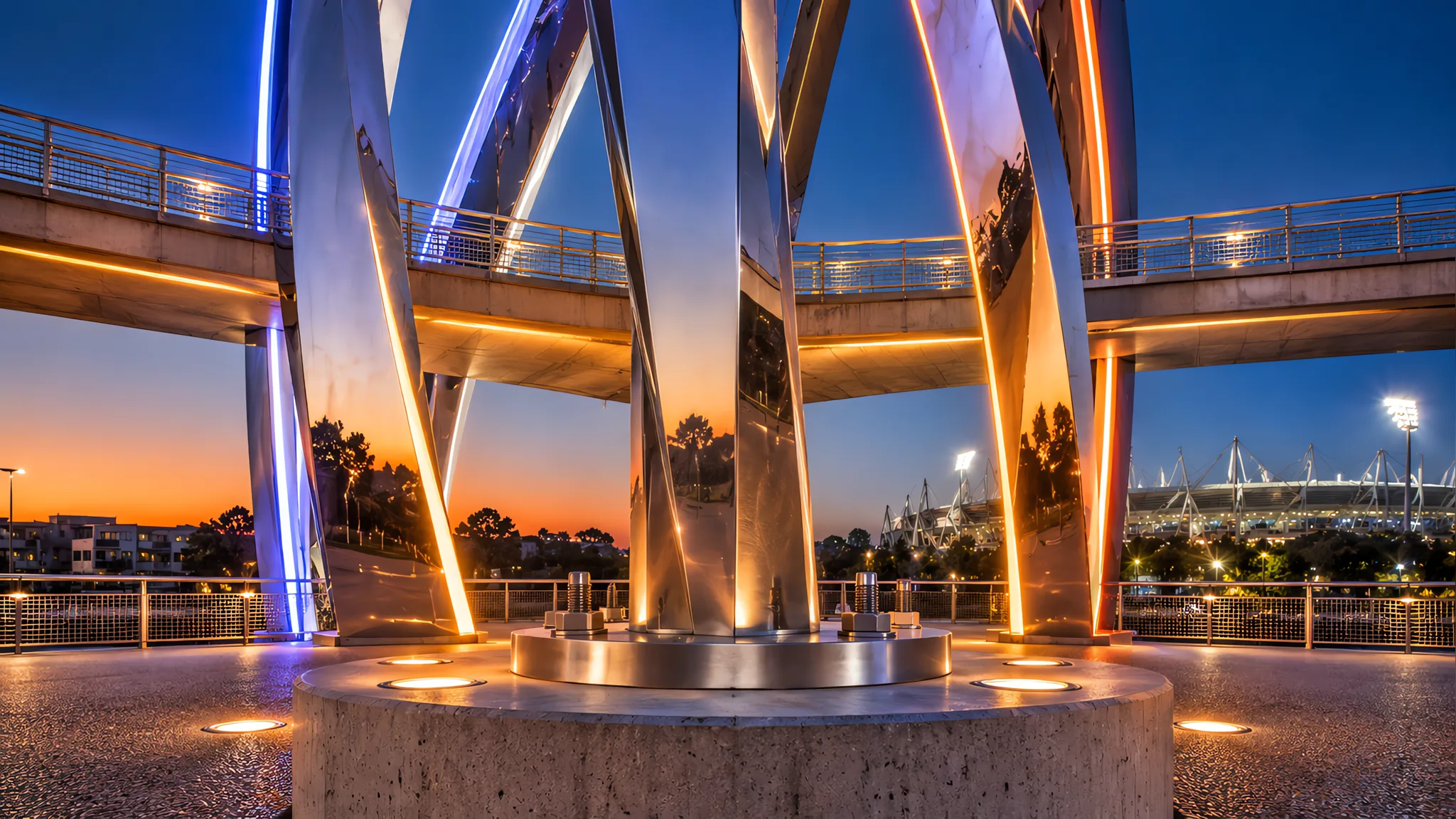
A cluster of 12 tapered fins rising from a central mast, each fin rotated 15° from its neighbour to create a continuous spiral. The fins are spaced so the pedestrian bridge passes through the centre of the cluster, giving visitors an immersive “inside the sculpture” moment. At night, each fin carries an integrated RGBW LED strip; the system is DMX-controlled and synchronized with the stadium’s event lighting.
Material & engineering
316 stainless for the coastal-desert air and the salt-laden winds that funnel through the stadium bowl. Fins are 8 mm plate with a folded trailing edge, welded to a 300 mm central spine. The spine is a rolled 400 mm CHS section, designed for a 4.8 kN/m² gust load with the fins at their most adverse angle. Foundation is a 3.5 m × 3.5 m × 2.0 m reinforced concrete pad with 48 M36 anchor bolts.
Fabrication & finish
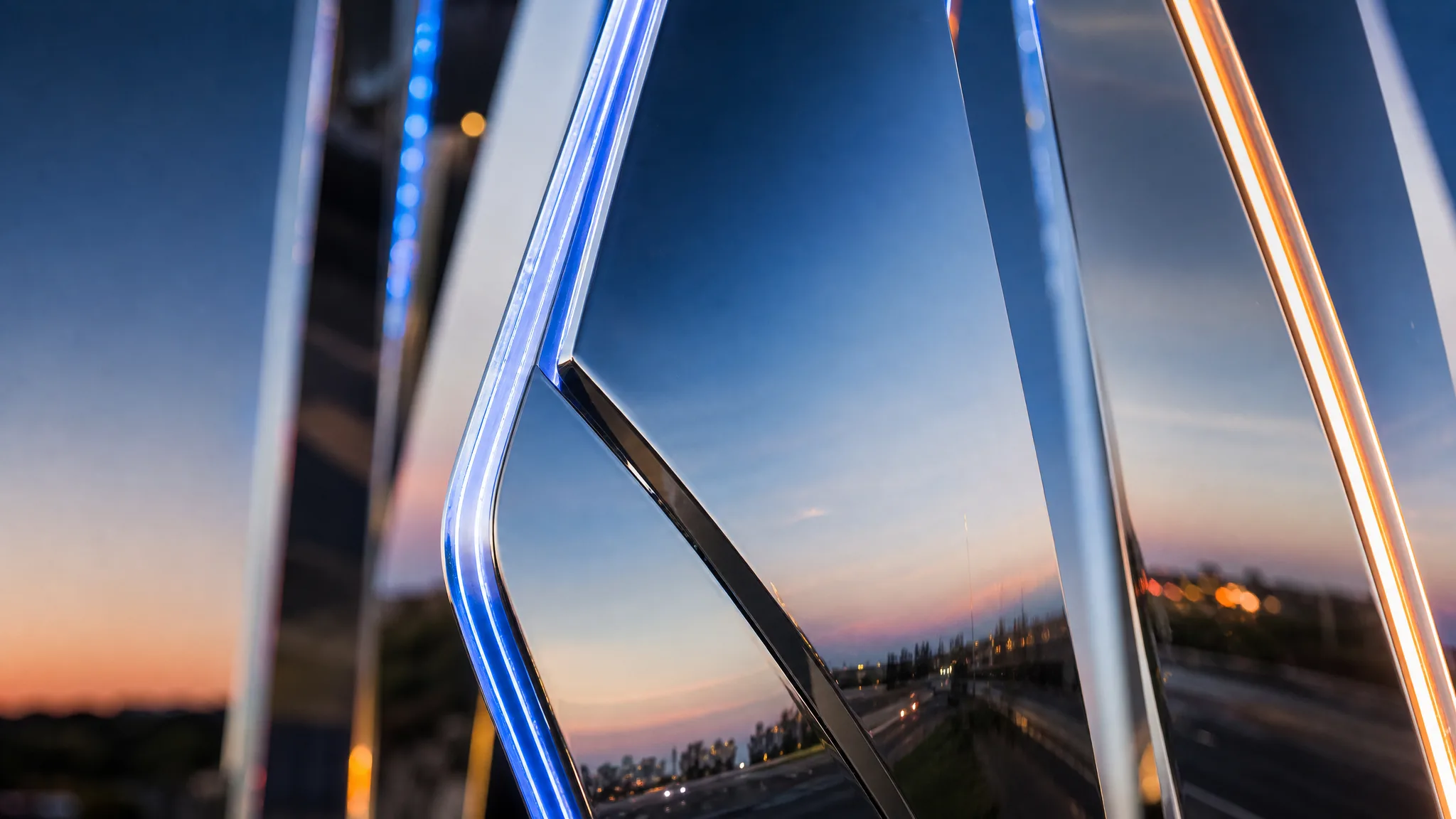
Fins were jig-welded to the spine in two 9 m sections, trial-erected in the workshop, then shipped in two loads. Bead-blasting was chosen for the fins — it gives a uniform matte surface that reads as a single volume in daylight and takes coloured light evenly at night. The mast is satin-finished to reduce glare for drivers on the adjacent arterial.
Installation
Installed over three consecutive night closures of the precinct. The base section was grouted and levelled on night one; the upper sections were flown in and bolted on nights two and three. The lighting control system was commissioned during the day-three closure, with the stadium’s lighting designer on site.
Outcome & value
The sculpture has become the stadium’s visual signature — appearing on membership cards, broadcast graphics and wayfinding signage. Maintenance is an annual abseil clean; the LED system is rated for 100,000 hours and the DMX drivers are in a ground-level cabinet for easy access.